
Quick Answer: You can get a San Antonio car accident report by ordering the Texas Peace Officer’s Crash Report, also called a CR-3, through the TxDOT Crash Report Online Purchase System or by requesting it from SAPD. SAPD says crash reports can take up to 14 days to appear in TxDOT’s system, and Texas law requires an officer who investigates a qualifying crash to file the report with TxDOT within 10 days. A regular copy costs $6, and a certified copy costs $2 more. Ryan Orsatti Law helps injured people in San Antonio obtain and review crash reports when evaluating fault, insurance coverage, and next steps. (Texas Department of Transportation)
Key Takeaways
- A San Antonio crash report is usually requested through TxDOT online or through SAPD Records.
- The report is commonly called a Texas Peace Officer’s Crash Report or CR-3.
- SAPD says reports can take up to 14 days to appear in TxDOT’s system.
- Texas law allows certain people with a proper connection to the crash to obtain the report, including involved drivers, vehicle owners, authorized representatives, and insurers.
- Do not assume the crash report is perfect. Check names, insurance, vehicle information, location, narrative, contributing factors, and the diagram.
- If you were hurt, the report is only one piece of the claim. Medical records, photos, witness information, vehicle damage, and insurance coverage also matter.
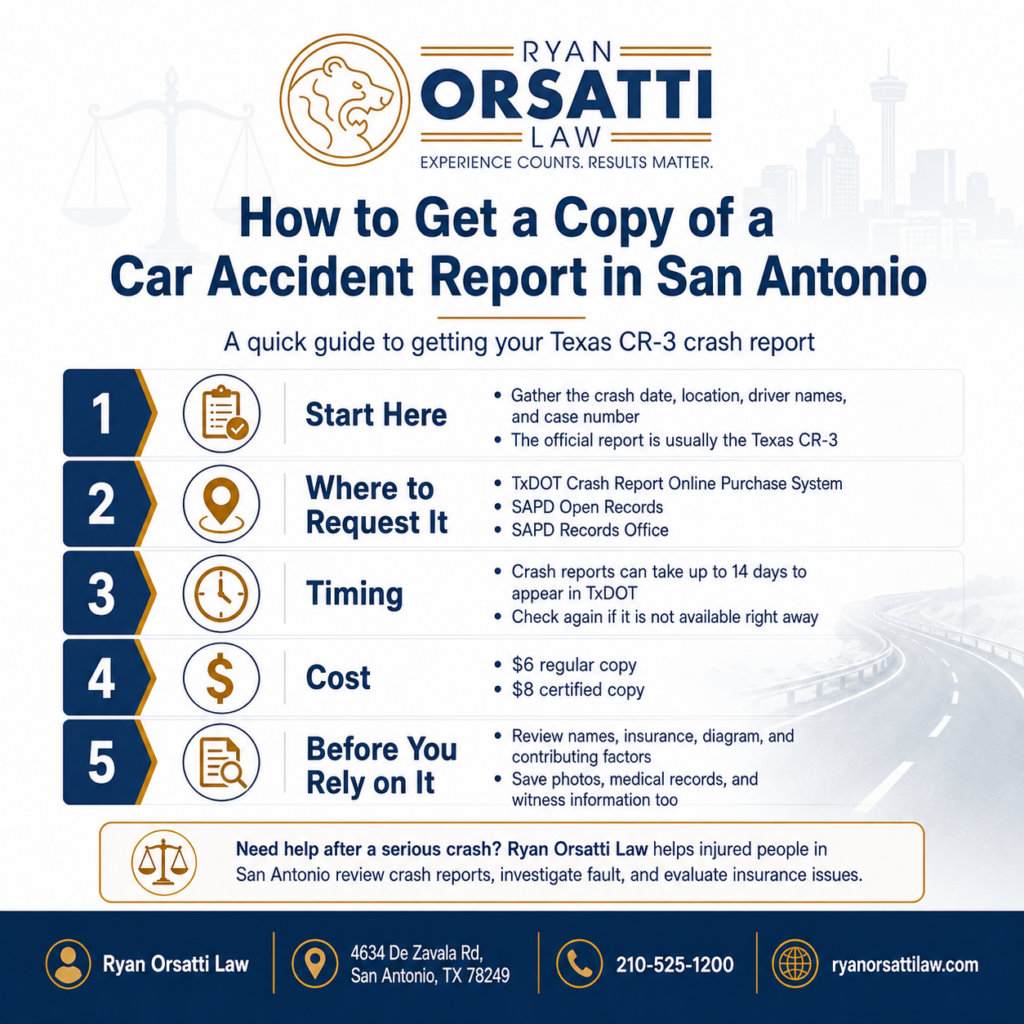
How do I get a copy of a car accident report in San Antonio?
You can get a copy of a car accident report in San Antonio either through TxDOT’s online crash report system or through the San Antonio Police Department’s open records process. The fastest route for most people is the TxDOT online system because TxDOT emails the report after purchase, but SAPD also accepts online, mail, and in-person requests. (Texas Department of Transportation)
The practical first step is to search TxDOT if the crash was investigated by SAPD, Bexar County Sheriff’s Office, DPS, or another Texas law enforcement agency. If the report is not available yet, check again after a few days and keep your crash date, location, driver names, and SAPD case number handy.
Step-by-step checklist to request your San Antonio crash report
- Write down the crash details. Use the date, time, location, names of drivers, and the SAPD case number if you have it.
- Search the TxDOT Crash Report Online Purchase System. TxDOT provides online access to purchase a CR-3, and the report is emailed after purchase. (Texas Department of Transportation)
- Wait if the report is not posted yet. SAPD says reports can take up to 14 days to appear in the TxDOT system. (San Antonio)
- Use SAPD Open Records if needed. SAPD allows police open records requests for crash reports, incident reports, calls for service, towing records, 911 calls, and body or dash camera footage. (San Antonio)
- Request in person or by mail if online does not work. SAPD Records Office is located at 315 S. Santa Rosa, San Antonio, TX 78207, and SAPD lists public hours as Monday through Friday, 9 a.m. to 4 p.m. (San Antonio)
- Save a PDF copy and send it to your lawyer or insurer. Keep the original email receipt, report PDF, photos, medical paperwork, and claim numbers in one folder.
| Request method | Best for | What you need | Cost or timing |
|---|---|---|---|
| TxDOT online system | Most San Antonio crash reports | Crash date, county, location, driver name, or report details | $6 regular copy; certified copy costs $2 more under Texas law |
| SAPD online open records | SAPD-related records beyond the CR-3 | Case number if known, or two or more details such as date, location, names, and basic description | SAPD says reports may take up to 14 days to appear in TxDOT |
| SAPD in person | People who need help with the request or payment | Completed request form and identification if required | SAPD Headquarters, 315 S. Santa Rosa, Monday to Friday, 9 a.m. to 4 p.m. |
| SAPD by mail | People who prefer paper requests | Completed form mailed to SAPD Records Office | Payment generally by check or money order for mail requests |
| Bexar County or other agency | Crashes outside SAPD response area | Crash date, location, names, county, and agency if known | Bexar County directs accident report requests to TxDOT |
Key takeaway: Start with TxDOT for the CR-3, but use SAPD Open Records when you also need related police materials such as 911 calls, body camera footage, dash camera footage, or towing records.
What is a Texas CR-3 crash report?
A Texas CR-3 is the official Texas Peace Officer’s Crash Report prepared by a law enforcement officer after a reportable motor vehicle crash. In Texas, an officer who investigates a crash must make a written report if the crash caused injury, death, or at least $1,000 in apparent property damage to any one person’s property.
TxDOT uses CR-3 data to maintain Texas crash records and publish statewide crash statistics. That matters because the report is not just paperwork. In 2024, TxDOT reported one reportable crash every 57 seconds in Texas, and its crash facts were based on CR-3 reports received and processed by the department.
A CR-3 often includes:
- Crash date, time, and location
- Drivers, passengers, vehicle owners, and insurers
- Vehicle information
- Injury information
- Road, weather, lighting, and traffic control details
- Contributing factors listed by the officer
- A crash diagram
- A narrative or officer comments
- Citation or charge information if included
The CR-3 is important, but it is not the entire case. Insurance adjusters often use it early, but photos, witness statements, medical records, vehicle damage, event data, video, and roadway evidence can change how fault and damages are evaluated.
Who can get an unredacted car accident report in Texas?
Texas Transportation Code § 550.065 limits access to unredacted crash reports, but it allows release to people directly concerned in the collision or with a proper interest. That includes involved drivers, authorized representatives, vehicle or damaged-property owners, certain parents or legal guardians, insurers, and others listed in the statute.
A redacted report may be available to people who do not qualify for the full report. Redacted means private information is removed, such as certain names, license numbers, dates of birth, addresses, phone numbers, license plates, insurance companies, and policy numbers.
In plain English, you usually qualify for the full report if you were involved in the crash, owned a damaged vehicle, represent someone involved, are a parent or guardian of an involved driver, or are connected through an insurance policy. If you are not sure which category applies, ask before submitting the wrong request.
How long does it take to get a San Antonio accident report?
A San Antonio accident report often takes days to become available, and SAPD says reports can take up to 14 days to appear in TxDOT’s system. Texas law gives an investigating officer until the 10th day after the collision to file a required CR-3 electronically with TxDOT. (San Antonio)
A delay does not always mean something is wrong. Reports can take longer when the crash involved serious injuries, a fatality, multiple vehicles, unclear identities, hit-and-run facts, commercial vehicles, or supplemental investigation.
If the report is not available after two weeks, try these steps:
- Search again using different details, such as the county, date, driver name, or crash location.
- Check whether SAPD, Bexar County Sheriff’s Office, DPS, or another agency investigated the crash.
- Contact SAPD Open Records if the crash happened inside San Antonio.
- Keep your own evidence organized while waiting.
- If you were injured, do not delay medical care or insurance notice just because the CR-3 is not ready.
What information do I need to request the report?
The SAPD case number is the most useful search detail, but you can still request a report without it. SAPD says that if you do not know the case number, you should provide two or more details such as the incident date, location, names of people involved, and a basic description of the incident. (San Antonio)
For common names, include dates of birth when you can. For highway crashes on Loop 410, Loop 1604, I-10, I-35, US-281, or Highway 90, write down the direction of travel, nearest exit, cross street, and whether the crash happened on the main lanes, frontage road, ramp, shoulder, or intersection.
Useful details include:
- SAPD case number
- Crash date and approximate time
- County, usually Bexar County for San Antonio crashes
- Exact street, intersection, highway, exit, or mile marker
- Names of involved drivers
- Vehicle year, make, model, and license plate if known
- Insurance company names
- Your role in the crash, such as driver, passenger, owner, pedestrian, or representative
- Whether injuries, towing, 911 response, or citations were involved
What should I check when you receive the crash report?
You should check the crash report for identity errors, insurance errors, wrong locations, missing vehicles, missing passengers, inaccurate diagrams, and incomplete injury information. A mistake in a CR-3 can affect how an insurance adjuster evaluates liability, especially early in a San Antonio car accident claim.
Focus on the items that adjusters and lawyers look at first: the narrative, diagram, contributing factors, unit numbers, injury boxes, citation information, insurance entries, and whether the report correctly identifies who was driving each vehicle. If the report lists you as partly at fault, treat that as a serious issue and gather the evidence needed to respond.
Attorney Insight: A crash report can move an insurance claim quickly, but it can also create problems if the officer had limited information at the scene. In San Antonio cases, we often compare the CR-3 against photos, body camera references, 911 call timing, tow records, medical records, and roadway evidence before accepting the report’s version of events. A small mistake in unit numbers, lane direction, or insurance information can create unnecessary delay.
What if the San Antonio crash report is wrong?
If the San Antonio crash report is wrong, do not mark up the report and send your own edited version as if it were official. Instead, gather proof of the error and contact the investigating agency to ask whether a supplement or correction process is available.
Useful proof may include photographs, repair estimates, medical records, driver’s licenses, insurance cards, witness statements, dash camera video, intersection camera leads, and screenshots of the crash location. If the error affects fault, injury, insurance, or whether someone was in the vehicle, consider getting legal help before communicating with the insurer about the mistake.
Common report errors include:
- Wrong insurance carrier or policy information
- Misspelled names
- Missing passenger information
- Incorrect crash location
- Wrong direction of travel
- Incorrect lane description
- Incomplete injury notation
- Missing witness information
- A diagram that does not match vehicle damage
- Contributing factors assigned without complete evidence
Do I need the accident report before starting an insurance claim?
You do not always need the accident report before starting an insurance claim, but you should get it as soon as it is available. The report often helps identify the other driver, insurance company, vehicle owner, crash location, citation details, and the officer’s initial view of what happened.
Do not let the lack of a CR-3 cause you to miss medical care, lose photos, delay notifying your own insurer, or give an unprepared recorded statement. A recorded statement is an insurer’s audio or video interview about the crash, injuries, and claim. It can be used later to challenge your version of events.
If you were injured, Ryan Orsatti Law can help review the report, identify coverage issues, and evaluate whether the report leaves out evidence that should be preserved. The firm handles San Antonio car accident claims and related insurance issues, including UM/UIM coverage in Texas.
What if police did not come to the crash scene?
If police did not come to the crash scene, there may not be a CR-3 in the TxDOT system. TxDOT explains that drivers involved in a crash not investigated by an officer may be provided a CR-2 or similar local agency form, but that type of form is for the driver’s records and is not the same as an officer-filed CR-3. (Texas Department of Transportation)
Inside San Antonio, SAPD says certain incidents cannot be reported through its online reporting system because they require officer investigation, including incidents involving injury or death. For those situations, SAPD directs people to contact SAPD directly through the non-emergency number, 210-207-SAPD, or the appropriate local substation. (San Antonio)
If there was no police response, preserve your own proof immediately:
- Photograph all vehicles from multiple angles.
- Photograph the full crash scene, debris, skid marks, traffic signals, signs, and lane markings.
- Get driver’s license, insurance, and plate information.
- Get names and phone numbers for witnesses.
- Save dash camera footage before it overwrites.
- Get medical care if you feel pain, dizziness, confusion, numbness, or worsening symptoms.
- Notify your insurer, but avoid guessing about fault or injuries.
How can a lawyer use a San Antonio accident report?
A lawyer can use a San Antonio accident report to identify parties, insurance coverage, witnesses, crash location evidence, officer findings, and investigation leads. The CR-3 is often the starting point, not the ending point, for evaluating fault and damages in a Texas injury claim.
Ryan Orsatti Law reviews crash reports as part of a broader claim investigation. That may include checking liability coverage, PIP or MedPay, UM/UIM coverage, medical bills, subrogation, hospital liens, roadway evidence, and whether photos or video should be requested before it is lost. Subrogation means a health insurer may claim a right to be paid back from a settlement. A hospital lien is a legal claim a hospital may assert against part of a personal injury recovery.
If you want help understanding whether the crash report helps or hurts your claim, you can learn more about Ryan Orsatti Law’s personal injury practice or contact the firm.
FAQs
How do I get my SAPD accident report online?
You can request a San Antonio accident report online through TxDOT’s Crash Report Online Purchase System or through SAPD’s Open Records process. TxDOT emails purchased CR-3 reports after purchase, while SAPD also accepts online open records requests for crash reports and related police records. SAPD says crash reports can take up to 14 days to appear in TxDOT’s system. (Texas Department of Transportation)
How much does a San Antonio car accident report cost?
A standard Texas collision report costs $6. A certified copy costs an additional $2, making the certified version $8. Certified copies may be useful when a formal document is needed, but many insurance claim reviews begin with a standard PDF copy. SAPD also lists accident reports at $6 in its police open records fee schedule.
Can anyone get a Texas car accident report?
Not everyone can get an unredacted Texas car accident report. Texas Transportation Code § 550.065 allows full reports for people directly concerned in the collision or with a proper interest, such as involved people, authorized representatives, drivers, certain vehicle owners, and insurers. Other requesters may receive a redacted copy with private information removed.
What if my San Antonio crash report is not available after 14 days?
If your San Antonio crash report is not available after 14 days, search again using different details and confirm which agency investigated the crash. SAPD says reports can take up to 14 days to appear in TxDOT’s system, but complex investigations can take longer. You can also submit an SAPD Open Records request if the crash occurred inside San Antonio. (San Antonio)
Do I need a police report for a Texas car accident injury claim?
A police report is not the only evidence in a Texas car accident injury claim, but it is often important. It can identify the drivers, vehicles, insurers, crash location, officer narrative, diagram, and contributing factors. A lawyer will usually compare the CR-3 with photos, medical records, witness information, vehicle damage, and available video before evaluating liability.
What if the crash happened in Bexar County but outside San Antonio?
If the crash happened in Bexar County but outside San Antonio, the report may have been handled by the Bexar County Sheriff’s Office, DPS, or another local agency. Bexar County’s Central Records page directs accident and crash report requests to TxDOT. The TxDOT system is often the best starting point for Texas crash reports regardless of which Texas agency investigated. (Bexar County)
Can Ryan Orsatti Law get my accident report for me?
Ryan Orsatti Law can help injured people in San Antonio obtain and review crash reports as part of evaluating an injury claim. The report is reviewed with other evidence, including photos, medical records, insurance coverage, vehicle damage, witness information, and deadlines. Getting the CR-3 is often one of the first practical steps after a serious crash.
Ryan Orsatti Law
4634 De Zavala Rd, San Antonio, TX 78249
Phone: 210-525-1200
ryanorsattilaw.com
This blog is for informational purposes only, not legal advice. Reading it does not create an attorney-client relationship. Past results do not guarantee future results.
Hurt in an accident in San Antonio? Learn how a San Antonio car accident lawyer can help with your claim. Call 210-525-1200 or request a free consultation.
The firm works on a contingency fee. You pay nothing unless the firm recovers money for you, and that covers case expenses as well as the fee: if there is no recovery, you owe no attorney's fee and no case expenses. Ask for the fee agreement and read the fee and expense section before you sign anything.
Related San Antonio legal resources
Primary legal and public-data sources
- TxDOT: Texas crash reports, data, and statistics
- Texas Civil Practice and Remedies Code Chapter 33: proportionate responsibility
Ryan Orsatti Law
4634 De Zavala Road, San Antonio, TX 78249
General reference links. Consult each source for its current text.