
Quick Answer
Your doctor may need to give a deposition in a Texas personal injury case because medical records often show what treatment happened, but they may not clearly prove why the injury happened, whether the crash aggravated a prior condition, or what future care is reasonably needed. In Texas, a Civil Practice & Remedies Code § 18.001 medical-cost affidavit can help prove that past medical charges were reasonable and services were necessary, but it does not prove causation. A doctor’s sworn deposition lets both sides ask questions about diagnosis, causation, prognosis, future treatment, work restrictions, and impairment. Ryan Orsatti Law helps injured people in San Antonio and across Texas decide when treating-physician testimony is needed and how to prepare that proof.
Key Takeaways
- A doctor deposition can connect the injury, treatment, and future care to the crash in medical terms.
- Medical records may be admissible, but records alone may not explain causation, aggravation, future care, or disputed medical bills.
- Texas § 18.001 affidavits can help prove reasonable and necessary past medical expenses, but they do not prove that the defendant caused the injury.
- Under the Texas Rules of Civil Procedure, a deposition is sworn testimony where lawyers may examine and cross-examine the witness.
- Doctor depositions are more common when there is surgery, delayed treatment, pre-existing conditions, disputed causation, future care, or a defense medical challenge.
- Most Texas personal injury lawsuits must be filed within two years, with exceptions and shorter notice rules in some cases. (Texas Statutes)
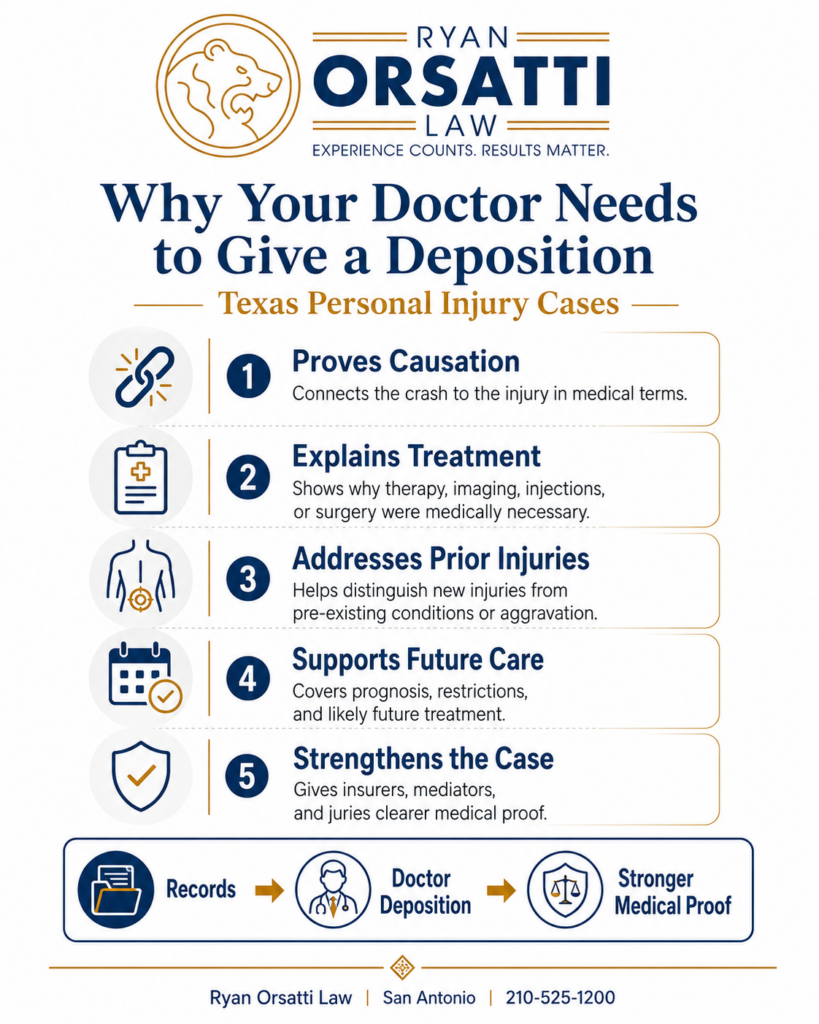
Why does my doctor need to give a deposition after an injury?
Your doctor may need to give a deposition because Texas injury claims often turn on medical causation, not just medical bills. Medical causation means proving that the wreck, fall, or other incident caused the injury, aggravated a prior condition, or made future treatment reasonably necessary.
This matters because insurance companies often separate the question of “Were you treated?” from “Was the treatment caused by this event?” For example, an MRI may show a disc herniation, but the defense may argue it was degenerative, pre-existing, unrelated, or not severe enough to explain the treatment.
TxDOT reported that 251,977 people were injured in Texas motor vehicle crashes in 2024, and many of those injury claims turn on medical proof, not just the crash report. (TxDOT) In San Antonio injury cases involving I-10, I-35, Loop 410, Loop 1604, or US-281 crashes, the medical testimony often becomes the bridge between the collision and the damages.
A deposition lets the doctor explain the chart in plain language. It can address diagnosis, mechanism of injury, treatment decisions, future care, and whether the patient’s complaints are medically consistent with the incident.
What is a doctor deposition in a Texas personal injury case?
A doctor deposition is sworn testimony taken before trial where lawyers ask the doctor questions under oath. In Texas civil cases, oral depositions are governed by Rule 199 of the Texas Rules of Civil Procedure, and the witness may be examined and cross-examined much like testimony in court.
The deposition usually happens in a lawyer’s office, doctor’s office, conference room, or remote setting. A court reporter records the testimony. In some cases, a videographer records it so the testimony can be used later in mediation or trial.
The doctor may testify about what the doctor personally observed, what treatment was provided, what the records mean, and what opinions the doctor holds based on training, experience, examination, imaging, and the patient’s medical history.
Is the doctor a regular witness or an opinion witness?
A treating doctor can be both a fact witness and an opinion witness in a Texas personal injury case. The doctor is a fact witness when describing the patient’s visits, exam findings, imaging, prescriptions, referrals, and treatment plan.
The doctor becomes an opinion witness when explaining diagnosis, causation, prognosis, impairment, treatment necessity, and future care. Under Texas Rule of Evidence 702, a qualified witness may give opinion testimony if specialized knowledge will help the fact finder understand the evidence or decide a fact issue. (Texas Courts)
For a patient, the distinction matters because the doctor is not just repeating records. The doctor may be asked to explain medical conclusions that a jury, judge, mediator, or adjuster cannot reliably infer from billing codes alone.
Why aren’t my medical records enough?
Medical records are often not enough because they document treatment, but they may not fully explain legal causation, future care, or disputed medical necessity. A chart note may say “neck pain after motor vehicle collision,” but that does not always answer the defense argument that the condition was old, unrelated, or caused by something else.
Texas evidence rules may allow certain medical records to come into evidence as business records, and statements made for medical diagnosis or treatment may fit a hearsay exception. But admissibility is not the same as persuasion. A record can be admitted and still leave unanswered questions.
Texas courts have recognized that medical causation sometimes requires testimony beyond common knowledge. In injury cases, the plaintiff may need to show not only that the crash happened, but that the crash caused the medical condition and the expenses being claimed.
What does a Texas § 18.001 affidavit prove, and what does it not prove?
A Texas § 18.001 affidavit can help prove that past medical charges were reasonable and the services were necessary, but it does not prove that the defendant caused the injury. That distinction is critical because an insurer may accept that a bill exists while still disputing whether the wreck caused the condition being treated.
The Texas Supreme Court has explained that § 18.001 creates a pretrial procedure that can reduce the need for live testimony on the reasonableness and necessity of medical expenses. But when a proper counteraffidavit challenges those expenses, the plaintiff may need testimony on the disputed amounts.
Causation remains a separate issue. A doctor deposition may still be needed even when the bills and records are organized, because the testimony may need to explain how the injury happened, why treatment was medically appropriate, and whether future care is reasonably expected.
What medical issues does the doctor usually need to explain?
The doctor usually needs to explain diagnosis, causation, treatment necessity, future care, work restrictions, and any pre-existing conditions. These issues are where insurance companies and defense lawyers often focus their challenges.
| Medical issue | Why it matters | Example testimony the doctor may give |
|---|---|---|
| Diagnosis and objective findings | Shows what injury the doctor identified, not just what symptoms the patient reported | Exam findings, imaging results, neurological signs, orthopedic tests, or pain patterns |
| Causation or aggravation | Connects the incident to the injury or explains how it worsened a prior condition | Whether the crash more likely than not caused or aggravated the condition |
| Medical necessity | Explains why treatment was reasonable for this patient | Why therapy, injections, imaging, pain management, surgery, or referrals were appropriate |
| Future medical care | Supports claims for treatment that may be needed later | Expected surgery, injections, therapy, medication, follow-up care, or monitoring |
| Work restrictions | Documents how the injury affects daily work and physical activity | Lifting limits, sitting limits, driving limits, missed work, or modified duty |
| Pre-existing or degenerative findings | Addresses common defense arguments | Whether a prior condition was asymptomatic, stable, or aggravated by the incident |
Key takeaway: A doctor deposition turns chart entries into an organized medical explanation that an adjuster, mediator, judge, or jury can evaluate.
When is a doctor deposition most likely needed?
A doctor deposition is most likely needed when the injury is serious, causation is disputed, or the defense is challenging the medical treatment. The more the case depends on medical judgment instead of simple records, the more valuable treating-doctor testimony can become.
Common examples include:
- Neck or back injuries with MRI findings
- Herniated discs, nerve compression, radiculopathy, or spinal injections
- Surgery recommendations
- Traumatic brain injury or concussion symptoms
- Delayed treatment after the incident
- Gaps in treatment
- Prior crashes, prior pain, or degenerative findings
- Future medical care claims
- High medical bills or disputed billing
- Commercial vehicle, 18-wheeler, or catastrophic injury cases
- A defense counteraffidavit challenging medical bills
- A case headed to mediation or trial
In a San Antonio car accident case, a deposition may be needed when the insurer argues that the crash was too minor to cause the injury. In a San Antonio truck accident case, medical testimony may be needed to explain the force of impact, the treatment course, and how a serious injury affects long-term function.
How can a doctor deposition affect settlement, mediation, and trial?
A doctor deposition can affect settlement, mediation, and trial by making the medical proof clearer and harder to ignore. It does not guarantee a result, but it can give both sides a better record for evaluating liability, causation, damages, and trial risk.
Before mediation, a doctor deposition may help show why treatment was needed, why future care is expected, and why a pre-existing condition defense does or does not fit the medical facts. At trial, deposition testimony may help the jury understand medical issues that are not obvious from records.
The reverse is also true. If the doctor has not reviewed prior records, cannot explain causation, or gives uncertain answers, the deposition can expose weaknesses. That is why deposition preparation matters.
Attorney Insight: Adjusters often discount an injury claim when records only list pain complaints, ICD codes, and treatment dates. A strong treating-doctor deposition does not merely repeat the chart. It explains what the doctor ruled in, what the doctor ruled out, why timing matters, and why the treatment plan made medical sense for this patient.
How long does a doctor deposition take, and who attends?
A doctor deposition may last less than an hour in a narrow dispute or several hours in a serious injury case. Under Texas Rule of Civil Procedure 199.5, no side may examine or cross-examine an individual witness for more than six hours, unless the rules or court allow otherwise.
The people who usually attend include the doctor, the plaintiff’s lawyer, the defense lawyer, a court reporter, and sometimes a videographer. The injured person may or may not attend, depending on strategy, logistics, and the lawyer’s advice.
The deposition can involve costs, including the doctor’s time, court reporter fees, transcript charges, video fees, and attorney preparation time. Those costs should be discussed with your lawyer before the deposition is scheduled.
What should I do before my doctor’s deposition?
Before your doctor’s deposition, your job is to make sure your medical history, symptoms, treatment, work limits, and prior conditions are accurately documented. You should not try to script the doctor’s testimony or ask the doctor to say something the medical facts do not support.
Use this checklist:
- Keep treating consistently. Missed appointments and treatment gaps often become defense arguments.
- Tell your doctors the truth. Prior injuries, prior crashes, old imaging, and pre-existing pain must be disclosed.
- Save key records. Keep imaging reports, referrals, prescriptions, work notes, discharge papers, and therapy instructions.
- Tell your lawyer about all prior injuries. Surprises in a deposition can hurt credibility and strategy.
- Do not exaggerate symptoms. Accurate reporting is usually more helpful than dramatic descriptions.
- Follow the treatment plan. If you cannot afford care or cannot attend appointments, tell your lawyer and your doctor.
- Avoid contacting the doctor about testimony unless your lawyer instructs you. Medical communication should stay accurate, appropriate, and documented.
- Ask about liens and repayment claims. Subrogation means a health insurer may claim a right to be paid back from a settlement. A hospital lien is a legal claim a hospital may assert against part of a personal injury recovery.
This preparation helps your lawyer understand whether the treating doctor can support the medical issues in dispute. It also helps avoid the most common problems: missing history, unclear symptom timing, incomplete records, and undocumented work restrictions.
Can the defense depose my doctor too?
Yes, the defense can often seek your doctor’s deposition once a Texas personal injury case is in litigation and the doctor has relevant information. The defense may also seek records from nonparties through the Texas discovery rules, subject to legal limits, objections, privacy protections, and court supervision.
Defense lawyers commonly ask doctors about prior injuries, alternative causes, degenerative findings, treatment gaps, billing practices, letters of protection, and whether the doctor relied on the patient’s history. A letter of protection is an agreement where a medical provider may wait for payment from a later injury recovery instead of requiring immediate payment from the patient.
This is one reason an injured person should be honest from the start. If prior back pain, a prior collision, or old imaging exists, your lawyer needs to know before the defense brings it up in a doctor deposition.
Does a doctor deposition mean my case is going to trial?
A doctor deposition does not necessarily mean your case is going to trial. Many Texas personal injury cases use doctor depositions before mediation, during litigation, or to preserve testimony, even if the case later resolves without a trial.
A deposition can help both sides evaluate the case more realistically. It can also preserve testimony if a busy physician cannot appear live at trial or if video testimony is expected to be used.
Still, a deposition is a serious litigation step. It should be planned around the issues that matter most: causation, medical necessity, future care, impairment, and the defense theories being raised.
How early should you decide whether your doctor needs to give a deposition?
You should start evaluating the need for a doctor deposition early, especially if your injuries are serious or the insurer is disputing causation. Waiting too long can create scheduling problems, discovery deadline issues, and unnecessary pressure before mediation or trial.
Most Texas personal injury lawsuits must be filed within two years under Texas Civil Practice & Remedies Code § 16.003, though some cases involve different or shorter deadlines. (Texas Statutes) Government claims, minor claims, wrongful death issues, and other special situations may require separate analysis.
A practical approach is to review the deposition issue once the key medical picture is clearer. That usually means after diagnosis, imaging, treatment plan, billing status, prior-record review, and future-care issues are known.
How does Ryan Orsatti Law use doctor depositions in Texas injury cases?
Ryan Orsatti Law uses treating-doctor depositions to clarify medical proof, address defense challenges, and prepare Texas personal injury cases for negotiation, mediation, or trial when the facts require it. The goal is to build a clear record, not to overcomplicate a case that can be proven another way.
For injured people in San Antonio, Bexar County, and across Texas, the firm evaluates whether records, bills, affidavits, doctor testimony, or additional medical review are needed. In serious cases, including catastrophic injury claims, doctor testimony may be one of the most important parts of proving how the injury changed the person’s work, daily life, and future medical needs.
Ryan Orsatti Law also helps clients understand when legal help matters after an injury claim becomes disputed. If the insurer is questioning your treatment, blaming old injuries, or pushing for a recorded statement before the medical facts are clear, it may be time to speak with a Texas personal injury attorney before more damage is done to the claim.
Frequently Asked Questions
Is my doctor’s deposition required in every Texas personal injury case?
No. A doctor deposition is not required in every Texas personal injury case. Some claims can be resolved with medical records, bills, affidavits, and clear documentation. A deposition becomes more likely when the insurer disputes causation, future care, surgery, pre-existing conditions, medical necessity, impairment, or the reasonableness of the bills.
Can medical records alone prove my injuries in a Texas car accident case?
Medical records can help prove your injuries, but they may not be enough when causation is disputed. Texas law may require medical testimony for conditions outside common experience, such as spine injuries, nerve symptoms, surgery recommendations, or complex aggravation issues. Records show treatment, but testimony can explain why the treatment relates to the crash.
Does a Texas § 18.001 affidavit replace my doctor’s deposition?
A Texas § 18.001 affidavit can sometimes reduce the need for testimony about whether past medical charges were reasonable and services were necessary. It does not prove that the defendant caused the injury, and a proper counteraffidavit can create a need for additional proof. A doctor deposition may still be needed for causation, future care, and disputed medical issues.
What if my doctor will not give a deposition?
If your doctor will not voluntarily give a deposition, your lawyer may evaluate other options allowed by the Texas discovery rules. Depending on the case, that may include a subpoena, deposition on written questions, testimony from another treating provider, a properly disclosed medical witness, or a different proof strategy. The right option depends on the medical issues and court deadlines.
Can the defense lawyer ask my doctor about old injuries?
Yes. The defense lawyer can often ask about old injuries if they are relevant to the injuries claimed in the lawsuit. Prior crashes, prior pain, old MRI findings, arthritis, degenerative changes, and treatment gaps are common deposition topics. Your lawyer needs a complete medical history so those issues can be addressed accurately.
Will I have to attend my doctor’s deposition?
You may not have to attend your doctor’s deposition, but your lawyer may recommend it in some cases. The decision depends on strategy, logistics, and whether your presence helps or distracts from the medical testimony. Even if you do not attend, your records, history, and treatment choices will likely be discussed.
Can a doctor deposition help prove future medical care?
Yes. A doctor deposition can help prove future medical care when the doctor can explain the need for treatment in medical terms. Future care may include surgery, injections, therapy, medication, follow-up visits, or restrictions. The testimony should be tied to the diagnosis, prognosis, and facts of the patient’s condition.
Should I talk to a lawyer before the insurance company disputes my treatment?
Yes, it is usually wise to talk to a lawyer before the insurance company builds a record against your medical claim. Once an adjuster focuses on treatment gaps, prior injuries, recorded statements, or causation disputes, your words and records may be used to reduce the claim. A lawyer can help evaluate what proof is missing.
Ryan Orsatti Law
4634 De Zavala Rd, San Antonio, TX 78249
Phone: 210-525-1200
ryanorsattilaw.com
This blog is for informational purposes only, not legal advice. Reading it does not create an attorney-client relationship. Past results do not guarantee future results.
Hurt in an accident in San Antonio? Learn how a San Antonio traumatic brain injury lawyer can help with your claim. Call 210-525-1200 or request a free consultation.
The firm works on a contingency fee. You pay nothing unless the firm recovers money for you, and that covers case expenses as well as the fee: if there is no recovery, you owe no attorney's fee and no case expenses. Ask for the fee agreement and read the fee and expense section before you sign anything.
Related San Antonio legal resources
Primary legal and public-data sources
Ryan Orsatti Law
4634 De Zavala Road, San Antonio, TX 78249
General reference links. Consult each source for its current text.