
Quick Answer
Do not post pictures of your vacation after an auto accident because the insurance company may use photos, captions, tags, and location check-ins to question your injuries, credibility, and damages. In Texas, relevant social media can become discoverable in litigation, and trial evidence rules focus on whether the post tends to make a disputed fact more or less probable. TxDOT reported 251,977 people injured in Texas motor vehicle crashes in 2024, so the way you document your life after a crash can matter in real claims. Ryan Orsatti Law helps injured people in San Antonio and across Texas evaluate these issues before a harmless-looking vacation post becomes a disputed exhibit. (Texas Department of Transportation)
Key Takeaways
- Vacation photos can be taken out of context, especially if they show travel, walking, swimming, nightlife, lifting luggage, or smiling through pain.
- Private accounts are not a complete shield. Relevant electronic data can still become part of Texas discovery.
- Do not delete or edit old posts without legal guidance. Preservation problems can create a separate dispute.
- Ask friends and family not to tag you, post trip photos of you, or comment about your recovery.
- Keep the full context privately documented, including pain flares, braces, medication, skipped activities, and travel accommodations.
- Texas injury lawsuits are generally subject to a two-year limitations period, but social media damage can happen within days of the crash. (Texas Statutes)
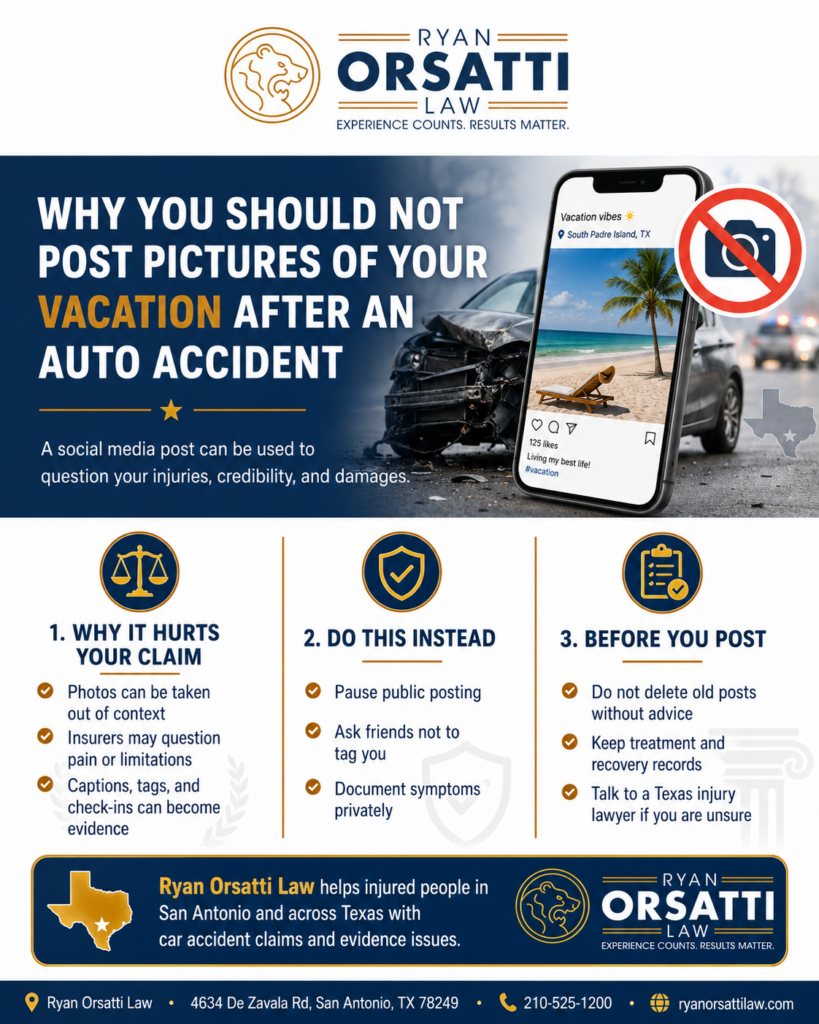
Why should you not post pictures of your vacation after an auto accident?
You should not post vacation pictures after an auto accident because the defense may use them to argue that your injuries are not as limiting as your medical records, pain reports, or lost-wage claim suggest. A photo does not have to prove you are uninjured to cause problems. It only has to create doubt.
Texas evidence law defines relevant evidence as evidence that tends to make a fact more or less probable and that relates to something that matters in the case. That means a beach photo, airport photo, restaurant photo, or “back to normal” caption may become part of a dispute about pain, physical limitations, causation, or credibility.
The risk is not that injured people can never travel. The risk is that social media strips away context. A person can smile in a photo and still have a herniated disc, concussion symptoms, medication side effects, or a doctor’s restriction. But an adjuster may still use the image as a shortcut argument.
For more general post-crash mistakes, Ryan Orsatti Law has also published a related guide on what not to do after a Texas car accident. That guide specifically warns against posting about the crash, injuries, activities, trips, recovery, check-ins, private messages, and deleted content while a claim is pending. (Ryan Orsatti Law)
Can vacation photos really be used against you in a Texas car accident claim?
Yes, vacation photos can be used against you if they are relevant to disputed issues such as injury severity, medical limitations, pain, lost income, or credibility. Discovery means the formal lawsuit process for requesting information from the other side. Texas Rule of Civil Procedure 192.3 allows discovery of nonprivileged matters relevant to the subject of the case, including documents, photographs, electronic recordings, videos, and data.
That does not mean every post will be admitted at trial. Admissible means a court may allow the evidence to be used at trial. Texas Rules of Evidence 401, 402, and 403 address relevance and the court’s ability to exclude some relevant evidence if the risk of unfair prejudice, confusion, or delay substantially outweighs its value.
| Vacation post or activity | How an insurer may try to frame it | Safer approach |
|---|---|---|
| Airport selfie with luggage | “You were able to travel and carry bags.” | Document who handled luggage, whether you used assistance, and whether travel increased symptoms. |
| Beach, pool, or hiking photo | “You were active and physically fine.” | Avoid posting. Keep private notes about what you could not do, breaks, pain, braces, and medication. |
| Caption saying “finally back to normal” | “You admitted recovery.” | Do not post broad recovery statements while still treating or symptomatic. |
| Restaurant or nightlife photo | “Your daily life was not disrupted.” | Avoid public activity posts. Medical records and private documentation should tell the full story. |
| Tagged photo by a friend | “Even your friends show you were active.” | Ask friends and family not to tag, check in, or post photos of you while the claim is pending. |
| Deleted vacation post | “You removed evidence after a dispute began.” | Do not delete, edit, or hide posts without legal advice. Preserve first, then ask what to do next. |
Key takeaway: The risk is not the vacation itself; the risk is allowing a short post to become the only context an insurer has for your post-crash limitations.
What Texas legal rules make social media risky after a crash?
Texas discovery and evidence rules make social media risky because posts can move from “personal content” to “case evidence” if they relate to a disputed injury claim. A vacation picture may be requested in discovery, challenged for relevance, used in settlement discussions, or offered at trial depending on the facts. The same can apply to captions, comments, check-ins, direct messages, videos, and tagged posts.
Comparative responsibility means Texas can reduce your recovery by your percentage of fault. Under Texas Civil Practice & Remedies Code § 33.001, a claimant may not recover damages if their percentage of responsibility is greater than 50 percent. Under § 33.012, damages can be reduced by the claimant’s percentage of responsibility. Vacation photos usually affect injury and damages arguments more than fault, but credibility disputes can influence the whole claim. (Texas Statutes)
Does making your account private protect you?
Making your account private helps limit casual viewing, but it does not guarantee that vacation photos are protected from a Texas injury claim. If a lawsuit is filed, relevant electronic information may still be requested through discovery. Privacy settings are not the same thing as a legal privilege.
Ryan Orsatti Law’s guide on digital evidence in Texas personal injury litigation explains that social media can be used to challenge credibility and injury extent. It also recommends avoiding case-related posts, reviewing privacy settings, and not deleting existing content without legal advice. (Ryan Orsatti Law)
Should you delete or edit vacation posts you already made?
Do not delete, edit, hide, or scrub vacation posts after an auto accident without legal guidance. Spoliation means the destruction or failure to preserve evidence when a duty to preserve may exist. Texas courts analyze whether a party had a duty to preserve evidence, whether that duty was breached, and what remedy fits the harm. (Justia Law)
If you already posted, preserve the content. Take screenshots, keep the original post available, save comments and captions, and tell your attorney. A bad post can often be explained with context. A deleted post can create a separate argument.
What should you do instead of posting vacation pictures after an auto accident?
Instead of posting vacation pictures after an auto accident, pause public activity updates and privately document the full truth of your recovery. If travel was planned before the crash, medically permitted, or unavoidable, the context matters. Medical restrictions, pain levels, accommodations, canceled activities, and treatment compliance can help explain what a photo does not show.
Use this checklist before posting anything after a Texas auto accident:
- Do not post about the crash. Avoid photos, videos, captions, comments, memes, or updates about how the wreck happened.
- Do not post about your injuries. Avoid pain updates, “I’m fine” comments, recovery jokes, or posts that oversimplify your condition.
- Do not post vacation pictures. Avoid activity photos, airport photos, pool photos, nightlife photos, hiking photos, and check-ins.
- Ask others not to tag you. Friends and family can accidentally create evidence by tagging you or commenting on your recovery.
- Do not accept unknown friend requests. Insurers and investigators may look for public information, and fake profiles are a real risk.
- Do not delete old posts without advice. Preserve first, then ask your lawyer how to handle the content.
- Keep private recovery notes. Track pain flares, missed activities, medication, sleep problems, braces, mobility aids, and doctor restrictions.
- Follow your medical plan. Missed appointments, treatment gaps, and public activity posts can be used together to challenge your claim.
Ryan Orsatti Law’s guide on evidence that can help a Texas car accident case notes that social media content can include admissions or statements that contradict injury claims. It also warns that insurers and defense attorneys may review photos, videos, check-ins, comments, and public posts. (Ryan Orsatti Law)
What if the vacation was planned before the crash or you had to travel?
A pre-planned or necessary vacation does not automatically defeat your Texas auto accident claim. The issue is whether the travel and the photos can be fairly explained in light of your injuries, restrictions, treatment, and daily limitations. If you had nonrefundable tickets, a family obligation, medical clearance, or significant accommodations, document that context privately.
For example, a person with a neck injury may still fly to a wedding but need medication, help with bags, extra rest, and limited activity. A person with a concussion may appear in one family photo but spend most of the trip avoiding noise, sunlight, and crowds. Those facts matter, but they are rarely visible in a social media post.
Attorney Insight: Adjusters rarely need a vacation photo to prove you are not hurt. They use it to create doubt. A photo showing you smiling at the beach may ignore that you sat out most activities, used medication, took breaks, wore a brace, or paid for nonrefundable travel before the wreck. The safer approach is to document the full context before the insurer frames it for you.
How do vacation posts affect medical bills, pain, and settlement discussions?
Vacation posts can affect medical bills, pain, and settlement discussions because insurers often compare social media activity against medical records and claimed limitations. Causation means the link between the crash and the injury. Damages means the losses claimed, such as medical bills, lost income, pain, impairment, and changes to daily life.
A single photo usually does not tell the full medical story. But it can become part of a larger argument if there are treatment gaps, missed therapy visits, inconsistent pain reports, delayed diagnosis, or broad captions like “fully recovered.” The more serious the injury claim, the more carefully your public activity may be reviewed.
This is especially true in cases involving back injuries, neck injuries, concussions, shoulder injuries, knee injuries, surgery recommendations, injections, lost wages, or long-term impairment. If the insurer believes your public posts conflict with your medical records, settlement discussions can become harder and slower.
When should you talk to a Texas personal injury lawyer before posting?
You should talk to a Texas personal injury lawyer before posting if you have ongoing symptoms, medical treatment, missed work, disputed fault, serious injuries, a UM/UIM issue, or a pending lawsuit. Texas personal injury lawsuits are generally subject to a two-year statute of limitations under Texas Civil Practice & Remedies Code § 16.003, but social media problems can develop long before that deadline. (Texas Statutes)
UM/UIM means uninsured or underinsured motorist coverage. It may apply when the at-fault driver has no insurance or not enough coverage. If your own insurance company is involved, your posts may still matter because your insurer can evaluate the injury claim much like an opposing carrier.
Talk to a lawyer before posting if the crash happened on a major San Antonio corridor such as Loop 1604, I-10, I-35, US-281, or Loop 410 and you are still treating. The same advice applies across Texas, including Bexar County, Comal County, Guadalupe County, Travis County, Harris County, Dallas County, Tarrant County, Hidalgo County, and surrounding areas.
How can Ryan Orsatti Law help with social media risks after a San Antonio crash?
Ryan Orsatti Law can help injured people evaluate how social media, medical records, insurance communications, crash evidence, and Texas deadlines fit together after an auto accident. The goal is practical claim protection, not panic. Many social media issues can be managed better when they are addressed early and honestly.
For San Antonio and Texas auto accident claims, Ryan Orsatti Law can review issues such as:
- What not to post while the claim is pending
- Whether existing posts should be preserved
- How vacation photos may be misread
- How to document travel limitations and symptom flare-ups
- How medical records and public posts may be compared
- How to respond if an adjuster asks about social media
- Whether a recorded statement should be delayed or limited
- How evidence should be gathered before it disappears
If you were hurt in a crash and are unsure whether a vacation post could hurt your claim, start with a private review before posting publicly. You can learn more about San Antonio car accident claims or contact Ryan Orsatti Law to discuss the situation. (Ryan Orsatti Law)
FAQ
Can the insurance company see private vacation pictures after a Texas car accident?
The insurance company may not automatically see private vacation pictures, but privacy settings are not a complete legal shield. If a lawsuit is filed, relevant photos, videos, captions, comments, and messages may be requested through Texas discovery. Do not assume “private” means protected. Avoid new posts, preserve existing content, and get legal guidance before deleting anything.
Is it okay to travel after an auto accident if my doctor says I can?
Yes, travel may be okay if your doctor permits it and you follow medical restrictions. The problem is not the trip by itself. The problem is public photos that make the trip look pain-free, unrestricted, or inconsistent with your medical records. Keep private notes about accommodations, symptoms, skipped activities, medication, and any pain flares during travel.
Should I delete vacation pictures if I already posted them after my crash?
No, you should not delete, edit, or hide vacation pictures without legal guidance. Deleting content after a claim or lawsuit begins can create a preservation dispute. Save screenshots, keep captions and comments, and tell your attorney what was posted. A photo with context is often easier to address than missing content.
Can a smiling vacation photo hurt my pain and suffering claim?
Yes, a smiling vacation photo can hurt a pain and suffering claim if it is used to suggest your injuries did not affect your life. The photo does not prove you were pain-free, but it can create doubt. That is why private documentation matters, including pain levels, limited activities, braces, medication, rest breaks, and canceled plans.
What should my family avoid posting after my car accident?
Your family should avoid posting photos of you traveling, lifting, dancing, swimming, hiking, partying, or appearing physically unrestricted after a car accident. They should also avoid tags, check-ins, crash updates, medical details, settlement comments, and “back to normal” captions. Even supportive posts can be taken out of context by an insurance company.
How long should I stay off social media after a Texas auto accident?
The safest approach is to avoid posting about your activities, travel, injuries, recovery, or claim while you are still treating or while the insurance claim is unresolved. Some cases last months, and some last longer. If you need to use social media, avoid case-related content, do not post vacation pictures, and ask your lawyer what is safe.
Ryan Orsatti Law
4634 De Zavala Rd, San Antonio, TX 78249
Phone: 210-525-1200
ryanorsattilaw.com
This blog is for informational purposes only, not legal advice. Reading it does not create an attorney-client relationship. Past results do not guarantee future results.
Hurt in an accident in San Antonio? Learn how a San Antonio personal injury lawyer can help with your claim. Call 210-525-1200 or request a free consultation.
The firm works on a contingency fee. You pay nothing unless the firm recovers money for you, and that covers case expenses as well as the fee: if there is no recovery, you owe no attorney's fee and no case expenses. Ask for the fee agreement and read the fee and expense section before you sign anything.
Related San Antonio legal resources
Primary legal and public-data sources
- TxDOT: Texas crash reports, data, and statistics
- Texas Civil Practice and Remedies Code Chapter 33: proportionate responsibility
Ryan Orsatti Law
4634 De Zavala Road, San Antonio, TX 78249
General reference links. Consult each source for its current text.