
Quick Answer
While you are hospitalized after an onshore Texas rig accident, your family should protect three things at once: your medical care, the required work-injury notices, and time-sensitive evidence. A family member can report the injury on your behalf, identify every company working at the site, verify workers’ compensation coverage, preserve your phone and protective equipment, and avoid speculative statements or releases while you are medicated. Texas generally requires employer notice within 30 days and a DWC Form-041 within one year, but important evidence may disappear much sooner.
Key Takeaways
- Designate one family member to communicate with the hospital, employer, insurers, and legal counsel.
- Give the employer prompt written notice, even when supervisors already know about the accident.
- Verify whether the employer is a workers’ compensation subscriber or nonsubscriber through the Texas Department of Insurance.
- Preserve clothing, personal protective equipment, photographs, texts, voicemails, work schedules, and the names of everyone involved.
- Do not let anyone pressure the injured worker into a recorded statement, release, or settlement while the worker is medicated or medically unstable.
- Serious rig accidents should be reviewed early because several contractors, equipment companies, operators, and insurance policies may be involved.
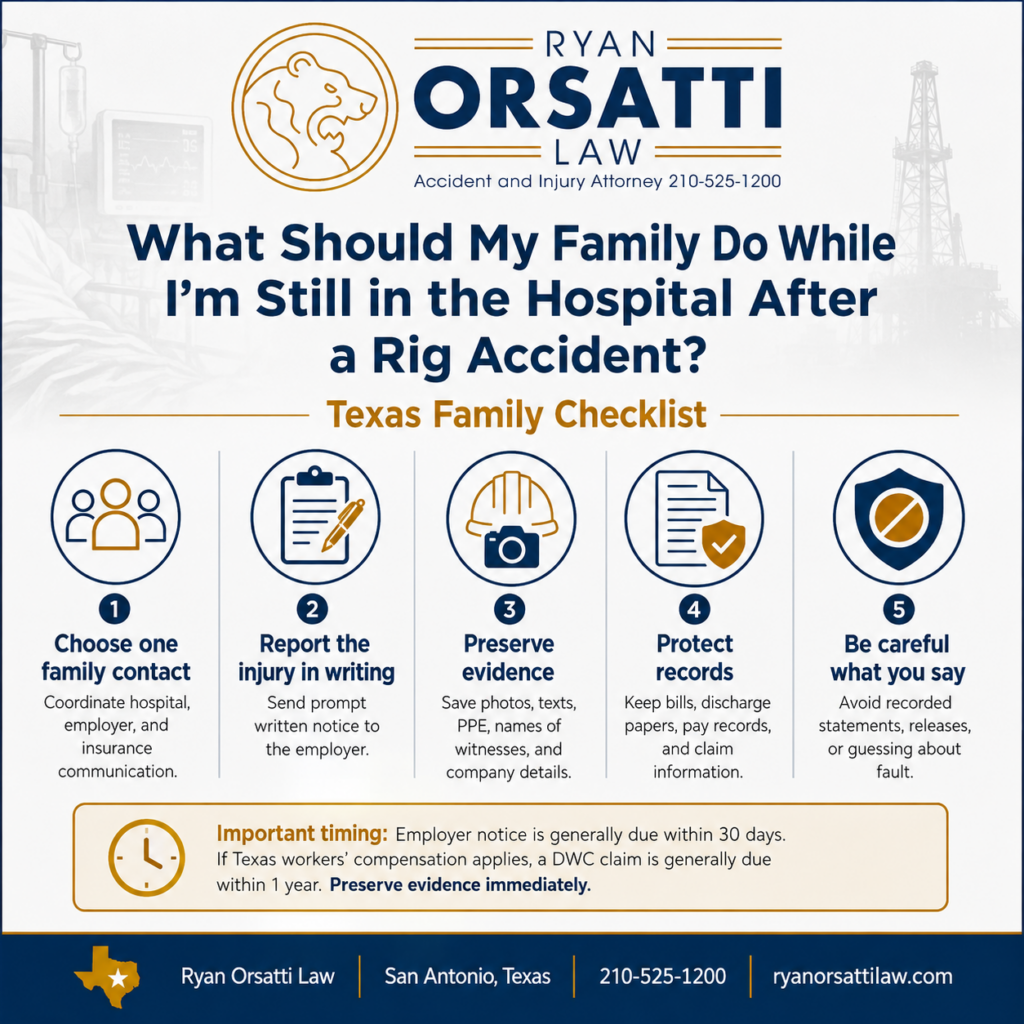
What Should My Family Do During the First 24 Hours?
Your family should use the first 24 hours to organize medical communication, document what is known, notify the employer in writing, and preserve evidence already within the family’s lawful possession. Medical stabilization comes first, but the family can protect the claim without leaving the hospital or attempting to investigate a restricted rig site.
Rig accidents deserve an organized response. The Texas Department of Insurance’s 2024 fatal-injury tables recorded 36 deaths in mining, quarrying, and oil and gas extraction, including 26 deaths in support activities for oil and gas operations. Those figures do not include the many workers who survive with burns, amputations, spinal injuries, brain injuries, crush injuries, or toxic-exposure conditions.
Use this initial checklist:
- Choose one family spokesperson. Give the hospital, employer, and other callers one reliable point of contact. This reduces conflicting information and helps the family maintain a complete communication log.
- Ask the hospital to document who may receive information. If the patient is alert and capable, ask the patient to authorize a spouse, parent, or other trusted person to receive updates and records.
- Write down the basic facts. Record the accident date, approximate time, county, lease or well location, employer, supervisor, job being performed, equipment involved, and the source of each fact.
- Send written notice to the employer. Email or text a supervisor, manager, safety representative, or human-resources contact. Save the sent message and any response.
- Identify the companies at the site. List the drilling contractor, lease operator, service companies, trucking companies, equipment owners, staffing companies, and any other contractors whose names appear on uniforms, vehicles, paperwork, or text messages.
- Preserve the worker’s phone and account data. Do not delete texts, photographs, voicemails, location data, work-group messages, shift instructions, or safety communications. Back up the phone when possible.
- Secure clothing and protective equipment. Preserve flame-resistant clothing, boots, gloves, hard hats, harnesses, respirators, monitors, and other items returned to the family. Do not clean, repair, test, or discard them.
- Save income and benefit records. Collect recent pay stubs, work schedules, overtime records, per diem information, health-insurance cards, disability-plan documents, and employee-benefit materials.
- Track every caller. Write down the caller’s name, company, telephone number, role, and what the person requested.
- Avoid unsafe investigation. Family members should not trespass, enter a restricted site, retrieve company equipment, interfere with an official investigation, or confront supervisors and coworkers.
What Information Should My Family Collect Before I Leave the Hospital?
Your family should collect information showing what happened, where it happened, who controlled the work, how the injury is being treated, and what coverage may pay the medical bills. No single document answers every question in a rig case, so a basic hospital file can prevent important names and records from being lost.
| Category | What to collect | Why it matters |
|---|---|---|
| Hospital care | Admission information, imaging reports, operative reports, discharge instructions, medication list, work restrictions, bills | Documents the injury, treatment, and immediate consequences |
| Employer and coverage | Employer’s full legal name, supervisor, carrier, claim number, adjuster, network notice, benefit-plan documents | Helps determine whether Texas workers’ compensation or another plan applies |
| Rig and site | County, lease name, well number or API number if known, nearest road, operator, drilling contractor, service companies | Identifies companies that may possess evidence or bear responsibility |
| Witnesses | Names, phone numbers, job titles, employers, crew assignments | Witnesses may move to another job or rotate off the site |
| Communications | Texts, group chats, voicemails, photographs, dispatch messages, work orders | May show instructions, warnings, equipment problems, or site conditions |
| Income | Pay stubs, overtime, bonuses, per diem, schedules, tax records | Helps document lost wages and earning history |
| Physical evidence | Clothing, PPE, personal tools, damaged personal items | May help explain the mechanism of injury or whether protective systems worked |
Key takeaway: The family does not need to solve the accident while the worker is hospitalized, but it should preserve enough identifying information for a focused investigation to begin.
Can My Family Report the Rig Accident for Me?
Yes. Under Texas Labor Code § 409.001, an employee or a person acting on the employee’s behalf may notify the employer of the injury. Notice generally must be given within 30 days and may be provided to the employer or an employee holding a supervisory or management position.
Do not wait until the worker is discharged merely because supervisors witnessed the event. Written notice creates a dated record and allows the family to confirm how the company identifies the employer, insurer, and claim administrator.
What Should the Written Injury Notice Say?
The written notice should be short, factual, and limited to information the family reasonably believes is accurate. It should identify the worker, date, location, work-related nature of the accident, hospitalization, and the person sending the notice.
A practical notice might read:
“[Worker’s name] was injured on [date] while performing work at [location or lease] and is currently hospitalized at [hospital]. The incident involved [brief description, if known]. Please confirm receipt of this notice and provide the employer’s workers’ compensation status, insurance carrier, claim number, adjuster, and any required reporting forms.”
The notice does not need to assign legal fault. Family members should not guess about equipment operation, safety procedures, worker conduct, or conversations they did not personally hear.
Does the Family Also Need to File a Workers’ Compensation Claim?
If the employer has Texas workers’ compensation coverage, the worker or someone acting on the worker’s behalf generally must file a DWC Form-041 within one year of the injury. Employer notice and filing the DWC claim are separate steps. Completing one does not necessarily complete the other.
Should My Family Give the Company a Recorded Statement?
Your family should provide necessary contact and medical-status information, but it should not speculate about how the accident happened or give a detailed recorded statement on the injured worker’s behalf. The worker may eventually have duties to cooperate with a workers’ compensation carrier, but any statement should occur when the worker is medically capable of understanding the questions and giving accurate answers.
Before participating, determine:
- Who is requesting the statement?
- Does the person represent the employer, workers’ compensation carrier, occupational-injury plan, site operator, contractor, or liability insurer?
- Is the call being recorded?
- Is the interviewer asking about medical history, safety rules, fault, or events the family did not witness?
- Is the worker taking medication that affects memory, alertness, or judgment?
The family should not sign a settlement agreement, release, resignation, broad medical authorization, benefit election, or document assigning responsibility without understanding its effect.
How Do We Find Out Whether the Employer Has Workers’ Compensation?
The family should verify coverage through the Texas Department of Insurance rather than relying only on what a supervisor calls the company’s benefit program. Texas private employers may choose whether to carry workers’ compensation in most situations. An employer with coverage is commonly called a subscriber, while an employer without Texas workers’ compensation is called a nonsubscriber.
TDI provides an online workers’ compensation coverage-verification process. If coverage remains unknown, TDI instructs users to submit the employer’s name, physical address, and injury date to its coverage-verification unit.
| Possible path | What it generally means | What the family should obtain |
|---|---|---|
| Workers’ compensation subscriber | Work-related medical and income benefits may be available; workers’ compensation is generally the exclusive remedy against the direct employer | Carrier, claim number, adjuster, network rules, DWC filings |
| Nonsubscriber employer | The employer does not carry Texas workers’ compensation; an employer negligence claim or contractual benefit plan may need review | Plan documents, incident reports, employer notices, arbitration provisions, insurance information |
| Third-party claim | A different company or equipment manufacturer may have contributed to the accident | Names of every company, contracts, site-control information, equipment identifiers |
| Offshore or federal claim | Federal compensation or maritime statutes may apply instead of the ordinary Texas framework | Vessel or platform information, offshore location, employer, job duties, transportation records |
Key takeaway: An “occupational accident plan” or “injury benefit plan” is not automatically the same as Texas workers’ compensation insurance.
When a subscriber’s worker also has a claim against another company, Texas law may allow both workers’ compensation benefits and a third-party claim. Subrogation means the compensation carrier may have a statutory right to seek repayment from money recovered from a responsible third party. See Texas Labor Code Chapter 417.
What Evidence Matters Most While I Am Hospitalized?
The most important evidence is the material that identifies the companies involved, the task being performed, the equipment used, the instructions given, and conditions immediately before the accident. The family should preserve evidence it already possesses and identify records that the companies should be asked to retain.
Potential evidence includes:
- The worker’s flame-resistant clothing, boots, gloves, hard hat, harness, respirator, eye protection, and gas monitor
- Photographs or videos taken before or after the event
- Text messages, work-group chats, dispatch instructions, and supervisor communications
- Shift schedules, timecards, fatigue-related communications, and crew assignments
- The lease name, well number, rig number, county, operator, and drilling contractor
- Witness names, telephone numbers, job titles, and employers
- Equipment brands, serial numbers, unit numbers, and ownership markings
- Job safety analyses, commonly called JSAs
- Lift plans, hot-work permits, lockout/tagout records, pressure-control records, and maintenance documents
- Rig-camera footage, vehicle telematics, electronic control-module data, alarm logs, and monitor downloads
- Incident reports, safety-meeting records, prior complaints, and near-miss reports
Some of these records will be controlled by an employer or contractor rather than the family. A prompt preservation notice can identify the specific equipment, electronic data, reports, and communications that should not be altered or destroyed. Ryan Orsatti Law’s broader guide to preserving health and evidence after a Texas oilfield accident explains why this work should begin early.
Attorney Insight: In serious rig cases, the first company report may reduce a complicated event to a single sentence. The actual case can turn on who controlled the task, what the JSA identified, whether equipment had been repaired, what cameras recorded, and who possessed stop-work authority. Preserving names, messages, PPE, and site identifiers allows later evidence requests to be specific rather than generic.
How Should My Family Handle Hospital Communication and Medical Records?
The family should designate one spokesperson, ask the patient to complete the hospital’s authorization forms when possible, and maintain a daily record of diagnoses, procedures, restrictions, and discharge planning. A spouse or relative does not automatically receive unrestricted access to all medical information merely because of the family relationship.
Under HIPAA, providers may speak with family members involved in care when the patient agrees or does not object. If the patient is incapacitated, the provider may share directly relevant information when professional judgment indicates that disclosure is in the patient’s best interest. A capable patient may also direct the provider in writing to send records to a designated family member.
The family should also:
- Make sure the chart accurately identifies the event as a work-related rig accident.
- Tell providers about every affected body part and symptom, including confusion, numbness, weakness, breathing problems, hearing changes, burns, and loss of consciousness.
- Record the names of surgeons, consulting physicians, therapists, and hospital case managers.
- Obtain discharge instructions, medication lists, work-status documents, and follow-up appointments.
- Keep copies of bills, explanations of benefits, and insurance correspondence.
- Avoid directing medical decisions based on requests from an employer or insurer. Treatment decisions should remain between the patient and qualified medical providers.
What Deadlines Matter While I Am Still in the Hospital?
The immediate deadlines depend on the coverage and parties involved, but a Texas rig-injury family should know the 30-day employer-notice deadline, the one-year DWC filing deadline, OSHA’s employer-reporting rule, and the general two-year limitations period for personal injury lawsuits. Evidence preservation should begin immediately even when the formal lawsuit deadline appears distant.
| Deadline or timing | Who is responsible | What it concerns |
|---|---|---|
| Generally within 30 days | Worker or person acting on the worker’s behalf | Notice of the work injury to the employer |
| Generally within one year | Worker or person acting on the worker’s behalf | Filing DWC Form-041 for a Texas workers’ compensation claim |
| Within 24 hours of a qualifying event | Employer | Reporting a qualifying inpatient hospitalization, amputation, or eye loss to OSHA |
| Generally within two years | Injured person or legal representative | Filing many Texas personal injury lawsuits |
| Immediately | Family and counsel | Preserving equipment, video, electronic data, reports, and witnesses |
Key takeaway: A two-year lawsuit period does not give the family two years to preserve footage, equipment condition, electronic data, or witness recollections.
Under 29 C.F.R. § 1904.39, the employer generally must report a qualifying inpatient hospitalization, amputation, or loss of an eye within 24 hours. The hospitalization must involve formal inpatient admission for care or treatment and generally must occur within 24 hours of the work incident. This is an employer obligation, not ordinarily the family’s reporting duty.
Texas personal injury lawsuits are generally subject to the two-year period in Texas Civil Practice and Remedies Code § 16.003. Different rules may apply to government claims, offshore injuries, occupational diseases, minors, incapacitated people, contractual benefit plans, and other special circumstances.
Who Pays the Hospital Bills After a Texas Rig Accident?
Who pays depends primarily on whether the employer carries Texas workers’ compensation, whether the claim is accepted, whether an employer benefit plan applies, and whether another company caused the accident. The family should provide available insurance information but should not assume that the first bill or collection notice identifies the party ultimately responsible.
Texas workers’ compensation can pay reasonable and necessary medical treatment for an accepted work-related injury and may replace part of lost wages when statutory requirements are met. If the employer is a nonsubscriber, an occupational-injury plan, health insurance, disability coverage, employer payments, or a third-party claim may become relevant.
A Texas hospital lien may attach to a negligence claim when the injured person is admitted within 72 hours of the accident. However, Texas Property Code § 55.003 states that the lien does not attach directly to a claim under Texas workers’ compensation law, although billing and reimbursement issues can still affect a related third-party recovery.
The family should keep every bill, payment notice, explanation of benefits, lien notice, and collection letter. Medical bills and repayment claims should be reviewed before any liability settlement is signed.
How Can a Lawyer Help While the Worker Is Still Hospitalized?
A Texas personal injury lawyer can verify coverage, identify all companies involved, send targeted preservation notices, coordinate communications, review benefit documents, and determine whether the matter involves workers’ compensation, a nonsubscriber claim, a third-party claim, product liability, or federal offshore law. Early involvement does not require rushing toward litigation or settlement.
Ryan Orsatti Law helps injured workers and families in San Antonio, South Texas, the Eagle Ford Shale region, and across Texas evaluate serious rig accidents. The investigation may include identifying who controlled the operation, who owned or maintained the equipment, what insurance applies, and which records should be preserved.
Related resources include:
- Texas oilfield accident claims
- Immediate steps after a Texas oilfield accident
- San Antonio catastrophic injury claims
- Contact Ryan Orsatti Law
The purpose of an early review is to protect accurate information, not to predict an outcome. The available claims and benefits depend on the worker’s employer, location, coverage, job duties, contracts, medical condition, and the conduct of each company involved.
Frequently Asked Questions
Can My Spouse Report My Rig Injury While I Am in the ICU?
Yes. Texas Labor Code § 409.001 permits an employee or a person acting on the employee’s behalf to notify the employer. Your spouse should send dated, written notice to the employer or a supervisor, identify the accident as work-related, state that you are hospitalized, request coverage information, and retain proof that the notice was delivered.
Should My Family Talk to the Company Investigator at the Hospital?
Your family may provide basic contact, location, and medical-status information, but it should not guess about fault or repeat secondhand accounts as fact. Ask the investigator’s name, employer, role, and whether the conversation is being recorded. A hospitalized worker should generally wait until medically capable of understanding and accurately answering detailed questions.
What If the Employer Says It Does Not Have Workers’ Compensation?
Verify that statement through the Texas Department of Insurance. If the employer is a nonsubscriber, request the complete occupational-injury plan, summary plan description, claim instructions, insurance information, and any arbitration or benefit-election documents. Nonsubscriber status may change the legal claims and defenses, but the worker must still establish the facts supporting employer or third-party responsibility.
Can My Family Go Back to the Rig and Take Photographs?
Only if the family has lawful permission and can do so safely. Do not trespass, enter a restricted worksite, interfere with regulators, or retrieve company property. Instead, preserve photographs already available, record the precise location and company names, identify witnesses, and have formal requests sent for site photographs, camera footage, equipment inspection, and electronic data.
What If the Accident Happened on an Offshore Rig?
Offshore cases may involve federal law rather than the ordinary Texas workers’ compensation framework. Depending on the location, vessel status, employer, and worker’s duties, the Outer Continental Shelf Lands Act, Longshore and Harbor Workers’ Compensation Act, Jones Act, or general maritime law may apply. The family should obtain the platform or vessel name, offshore location, employer, and transportation records promptly.
Who Pays the Hospital Bills After a Rig Accident?
A Texas workers’ compensation carrier may pay work-related medical treatment if the employer has coverage and the injury is compensable. If no Texas workers’ compensation exists, an employer plan, health insurance, disability coverage, or responsible third party may be involved. Hospital liens and reimbursement claims should be identified before settlement because they can affect how a third-party recovery is distributed.
Can My Employer Fire Me for Filing a Workers’ Compensation Claim?
Texas Labor Code § 451.001 generally prohibits an employer from discharging or discriminating against an employee because the employee filed a good-faith workers’ compensation claim, hired a lawyer for that claim, or participated in a workers’ compensation proceeding. Employment, medical-leave, attendance, and retaliation issues remain fact-specific, so the worker should preserve every related message and employment document.
Ryan Orsatti Law
4634 De Zavala Rd, San Antonio, TX 78249
Phone: 210-525-1200
ryanorsattilaw.com
This blog is for informational purposes only, not legal advice. Reading it does not create an attorney-client relationship. Past results do not guarantee future results.
Hurt in an accident in San Antonio? Learn how a San Antonio car accident lawyer can help with your claim. Call 210-525-1200 or request a free consultation.
The firm works on a contingency fee. You pay nothing unless the firm recovers money for you, and that covers case expenses as well as the fee: if there is no recovery, you owe no attorney's fee and no case expenses. Ask for the fee agreement and read the fee and expense section before you sign anything.
Related San Antonio legal resources
Primary legal and public-data sources
Ryan Orsatti Law
4634 De Zavala Road, San Antonio, TX 78249
General reference links. Consult each source for its current text.