
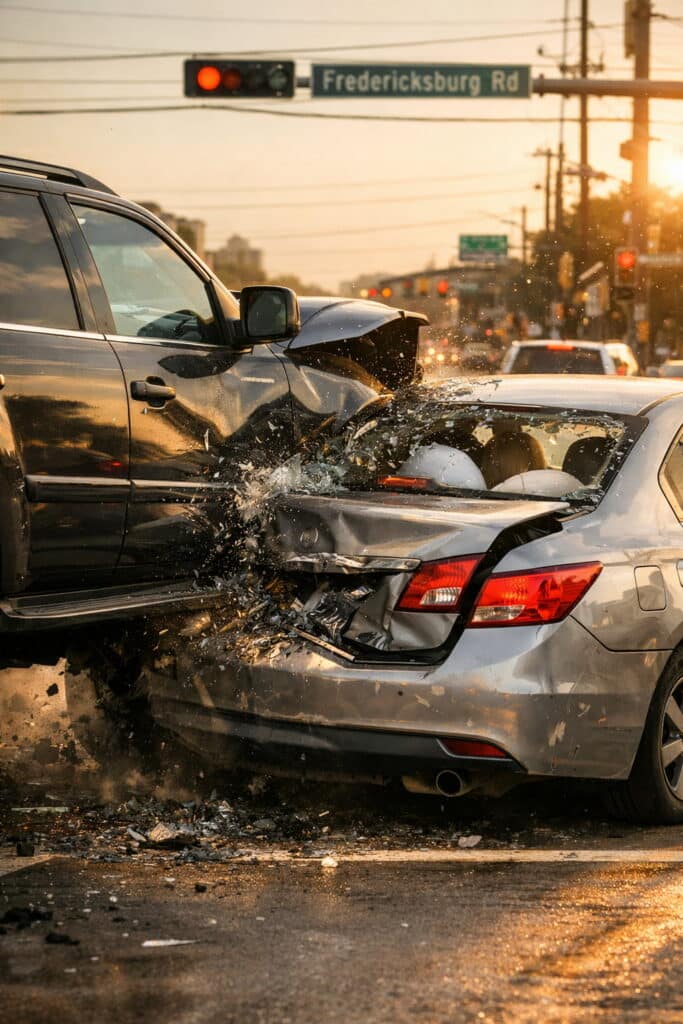
A passenger car sits at a stoplight on Fredericksburg Road. A full-size SUV strikes it from behind. The car’s rear crumple zones, engineered specifically to absorb that kind of impact, never engage.
The SUV’s bumper rides over them entirely, driving straight into the trunk, the rear glass, and in some cases the back seats. This is the bumper override problem, and it sits at the center of many SUV crash compatibility lawsuits filed in San Antonio each year.
SUV Crash Compatibility Lawsuits
- Bumper height mismatches between SUVs and passenger cars can cause an SUV’s front structure to bypass a smaller vehicle’s engineered safety systems entirely.
- When structural override occurs, injuries often affect the head, neck, and spine in ways that differ significantly from same-height vehicle collisions.
- Biomechanical experts and accident reconstruction specialists help establish how a vehicle’s geometry contributed to injury severity.
- Texas law allows injured parties to pursue compensation from drivers whose vehicles created foreseeable geometric hazards to others on the road.
- Multi-vehicle crashes involving SUVs often involve overlapping insurance claims, disputed liability, and complex causation arguments that benefit from early legal attention.
Why Bumper Height Mismatch Accidents in San Antonio Produce Different Injuries
Federal safety standards have long governed how passenger cars absorb crash energy. The National Highway Traffic Safety Administration sets requirements for bumper performance, but those requirements apply differently, and sometimes not at all, to light trucks and SUVs. The result is a fleet of vehicles sharing San Antonio roads with bumpers that sit at fundamentally different heights.
When two passenger cars collide, their bumpers meet bumper to bumper. Energy transfers through steel, compresses crumple zones, and deploys airbags in a sequence engineers designed decades ago. When a tall SUV strikes a shorter sedan, that sequence breaks down.
The SUV’s bumper may clear the sedan’s entirely, riding above the engineered absorption zone and contacting the vehicle’s body structure, windshield frame, or A-pillar instead.
The Mechanics Behind a Bumper Override Crash
A bumper override occurs when a striking vehicle’s front end is elevated enough to pass above the struck vehicle’s rear bumper and crumple zones. In practice, this means the impact energy bypasses every safety feature the smaller car’s manufacturer designed into the rear structure.
The passenger compartment absorbs forces it was never built to handle. Crash dynamics change significantly when this happens. Occupants of the smaller vehicle experience different force vectors than a standard rear impact would produce.
The seatbelt and airbag timing, calibrated based on expected crash geometry, may not deploy optimally when the override alters where and how force enters the vehicle.
Structural Integrity Failure in SUVs as a Legal Factor
A crash doesn’t have to involve a defective SUV for its geometry to become a legal issue. A fully functional SUV sitting several inches higher than the vehicle it strikes can still produce structural integrity failure in the smaller car simply by loading it in ways it wasn’t designed to handle. That distinction matters in litigation.
Attorneys pursuing bumper-height-mismatch accident claims often focus not on whether the SUV performed as designed, but on whether its design created a foreseeable hazard to other road users. These are different questions, and the second one can be pursued against a driver even when the manufacturer is not a party.
How Passenger Car vs. SUV Collisions Affect Crash Claims in San Antonio
San Antonio’s traffic patterns create frequent conditions for these collisions. Loop 410, US-281, and the intersections along Military Drive see heavy mixed-traffic flow throughout the day. Passenger cars, pickup trucks, full-size SUVs, and commercial vehicles share lanes at highway speeds.
When a chain-reaction crash involves multiple vehicle types, determining how each vehicle contributed to each occupant’s injuries becomes a layered, document-intensive process. Multi-vehicle claims complicate liability in several ways. Each driver carries separate insurance coverage.
Each insurer has an interest in minimizing its own exposure. When a bumper height mismatch between two of the vehicles caused injury patterns that wouldn’t have occurred in a standard crash, proving which vehicle produced which harm requires more than a police report.
Biomechanical Experts and What They Establish
Biomechanical experts are trained to connect vehicle dynamics to human injury. In bumper override cases, their analysis often addresses a specific question: would the occupant have sustained the same injuries if both vehicles had been the same height?
The answer, supported by crash data and human body mechanics, frequently reveals that override geometry increased both the severity and the type of injuries sustained. That testimony becomes a foundation for arguing that the SUV driver’s choice to operate a geometrically incompatible vehicle contributed meaningfully to the harm caused.
Accident Reconstruction in Geometric Incompatibility Cases
Accident reconstruction specialists examine physical evidence from the vehicles, the roadway, and available video to recreate the crash sequence. In passenger car vs. SUV collisions where override is suspected, they look for specific markers: scraping patterns above the sedan’s bumper line, intrusion into the passenger cabin from an unexpected direction, and damage inconsistent with a standard same-height impact.
This analysis helps establish not just that a crash occurred, but how it occurred, which is the evidentiary foundation for connecting the SUV’s geometry to the severity of injuries claimed.
Why Insurance Adjusters Dispute These Claims
Insurance companies in multi-vehicle crashes often contest whether a bumper height mismatch meaningfully contributed to injuries. Adjusters may attribute injury severity to pre-existing conditions, driver behavior, or the speed of impact rather than vehicle geometry. Without expert testimony establishing the override mechanism, those arguments can go unanswered.
Documentation gathered early, including photographs of both vehicles at the scene, preserves the physical evidence that experts later use to challenge those positions.
Texas Law and SUV Crash Compatibility Lawsuits
Texas follows a modified comparative fault system. Under Texas Civil Practice and Remedies Code § 33.001, an injured party may pursue compensation as long as their share of fault does not exceed 50 percent.
In SUV crash compatibility lawsuits, the at-fault driver’s liability may extend beyond basic negligence if it can be shown that operating a vehicle with known geometric incompatibility contributed to enhanced harm.
Texas also imposes a two-year statute of limitations on personal injury claims under Texas Civil Practice and Remedies Code § 16.003. That window applies regardless of how complex the liability questions become, making early case evaluation important.
How Fault Is Allocated When Multiple Vehicles Are Involved
When three or more vehicles are involved, fault can be distributed among multiple drivers. Each party’s percentage of responsibility affects how much compensation each injured person may recover.
When evidence establishes that vehicle geometry increased the severity of harm beyond what a standard impact would have produced, that factor can become part of a broader negligence and causation analysis.
What Documentation Strengthens a Bumper Height Mismatch Claim
Physical evidence from the crash itself carries significant weight in these cases.
Photographs taken at the scene showing the height differential between vehicles, damage patterns on both bumpers, and any point of contact above the smaller vehicle’s rear structure all support the geometric incompatibility argument.
Medical records connecting the nature of injuries to an override-type impact, repair estimates documenting where and how the vehicles were damaged, and any available dashcam or surveillance footage contribute to a more complete picture of what occurred.
A few other items worth preserving include:
- Contact and insurance information for all drivers involved, not just the one who struck your vehicle
- Statements from witnesses who observed the sequence of events
- Records of all medical treatment sought, even if symptoms appeared days after the crash
- Written communication from any insurance adjuster, including settlement offers
Keeping these materials organized gives a legal team the raw material to build a thorough claim.
What to Do After a Passenger Car vs. SUV Collision in San Antonio
Following medical advice is the single most consistent factor in protecting a claim. Gaps in treatment, or waiting to seek care, create openings for insurance adjusters to argue that injuries weren’t serious or weren’t caused by the crash. A documented, continuous course of medical evaluation ties the harm to the event.
Bringing all available documentation to an initial consultation with an attorney allows that attorney to assess what experts may be needed, which vehicles should be examined before repairs are made, and which insurance policies are in play.
Acting before vehicles are repaired or released from storage can be especially important in override cases, where the physical evidence is often the clearest proof of what happened.
FAQs for SUV Crash Compatibility Lawsuits
What makes a bumper height mismatch accident different from a standard rear-end crash?
In a standard rear-end crash between same-height vehicles, the struck car’s engineered safety systems absorb impact energy the way they were designed to. When a taller SUV strikes a shorter sedan, the SUV’s front end may bypass those systems entirely, loading the passenger compartment with forces the car was never built to handle.
That geometric mismatch can produce more severe injuries and changes the legal analysis around how fault is assigned.
Can the SUV driver be held responsible even if they weren’t driving recklessly?
Negligence in Texas doesn’t require reckless behavior. A driver who operates a vehicle that creates foreseeable hazards to others on the road may bear legal responsibility for harm that results, even if they were simply following traffic laws. Whether an SUV’s height differential rises to that level is a fact-specific question that depends on the crash circumstances and available evidence.
How does structural integrity failure in an SUV affect a multi-vehicle claim?
Structural integrity failure in the smaller vehicle, caused by impact from a vehicle whose geometry bypassed its safety systems, can be documented through expert analysis and physical evidence. That documentation helps establish the causal link between the SUV’s design and the injuries sustained, which is essential for pursuing compensation beyond what a standard impact would have produced.
Why do these cases often involve multiple insurance policies?
Multi-vehicle crashes bring multiple drivers and their separate insurers into the picture. Each insurer evaluates its own policyholder’s exposure and may contest liability or injury claims independently. An attorney can coordinate communication across all policies, identify coverage that might otherwise be overlooked, and present a consistent, evidence-backed account of what happened to each insurer.
What if the at-fault driver claims the sedan’s condition contributed to the crash severity?
Comparative fault arguments are common in these cases. If an insurer or opposing counsel argues that the sedan’s age or condition worsened the outcome, a structural engineer or accident reconstructionist can evaluate whether the vehicle performed within expected parameters for its design.
That analysis often counters the argument that anything other than the override geometry was responsible for the additional harm.
When the Road Ahead Feels Uncertain
What happened on that road doesn’t have to define what happens next. San Antonio streets mix every vehicle type imaginable, and when geometry turns a routine crash into something far more serious, the path forward can feel overwhelming.
Our team at Ryan Orsatti Law works with biomechanical experts and accident reconstruction specialists who know how to translate the physics of a crash into a clear legal argument. We offer free consultations, and we’re available when you’re ready to talk, on your schedule, without pressure. Reach out to us and let’s look at what the evidence shows.
Hurt in an accident in San Antonio? Learn how a San Antonio car accident lawyer can help with your claim. Call 210-525-1200 or request a free consultation.
The firm works on a contingency fee. You pay nothing unless the firm recovers money for you, and that covers case expenses as well as the fee: if there is no recovery, you owe no attorney's fee and no case expenses. Ask for the fee agreement and read the fee and expense section before you sign anything.
Related San Antonio legal resources
Primary legal and public-data sources
- TxDOT: Texas crash reports, data, and statistics
- Texas Civil Practice and Remedies Code Chapter 33: proportionate responsibility
Ryan Orsatti Law
4634 De Zavala Road, San Antonio, TX 78249
General reference links. Consult each source for its current text.