
Quick Answer
After an 18-wheeler accident on the Texas border, get medical help, call law enforcement, identify the tractor, trailer, driver, motor carrier, and insurance information, then preserve evidence before logs, camera footage, GPS data, and dispatch records become harder to obtain. Texas generally gives injured people two years to file a personal injury lawsuit, but commercial trucking evidence can disappear much sooner. Mexico-domiciled carriers transporting freight into the United States must have a USDOT number, an FMCSA-assigned MX number, and proper FMCSA authority or registration. (Texas Constitution and Statutes) Ryan Orsatti Law helps injured people in San Antonio, South Texas, and across Texas evaluate fault, insurance coverage, medical bills, and evidence preservation after serious truck crashes.
Key Takeaways
- Texas border truck crashes often involve more parties than a regular car wreck, including the driver, motor carrier, trailer owner, freight broker, shipper, maintenance vendor, or Mexico-domiciled carrier.
- Laredo is a major commercial truck gateway. The Bureau of Transportation Statistics reported that Laredo handled 2,945,388 inbound truck crossings from Mexico in 2025, or 38.8% of all truck traffic from Mexico. (Bureau of Transportation Statistics)
- Do not rely only on the police report. A Texas Peace Officer’s Crash Report, also called a CR-3, is important, but truck cases often turn on electronic logs, GPS, dash cameras, dispatch records, maintenance files, inspection history, and load documents.
- Texas proportionate responsibility means your claim can be reduced by your percentage of fault, and you may be barred from recovery if you are found more than 50% responsible. (Texas Constitution and Statutes)
- Commercial trucking insurance is different from personal auto insurance. FMCSA lists a $750,000 bodily injury and property damage insurance requirement for many for-hire non-hazardous property carriers with vehicles at or above 10,001 pounds GVWR, with higher limits for some hazardous materials. (FMCSA)
- Serious border truck crashes should be investigated quickly, especially on corridors like I-35 in Laredo, I-2 and US-83 in the Rio Grande Valley, I-10 near El Paso, Loop 20, US-281, and roads serving ports of entry.
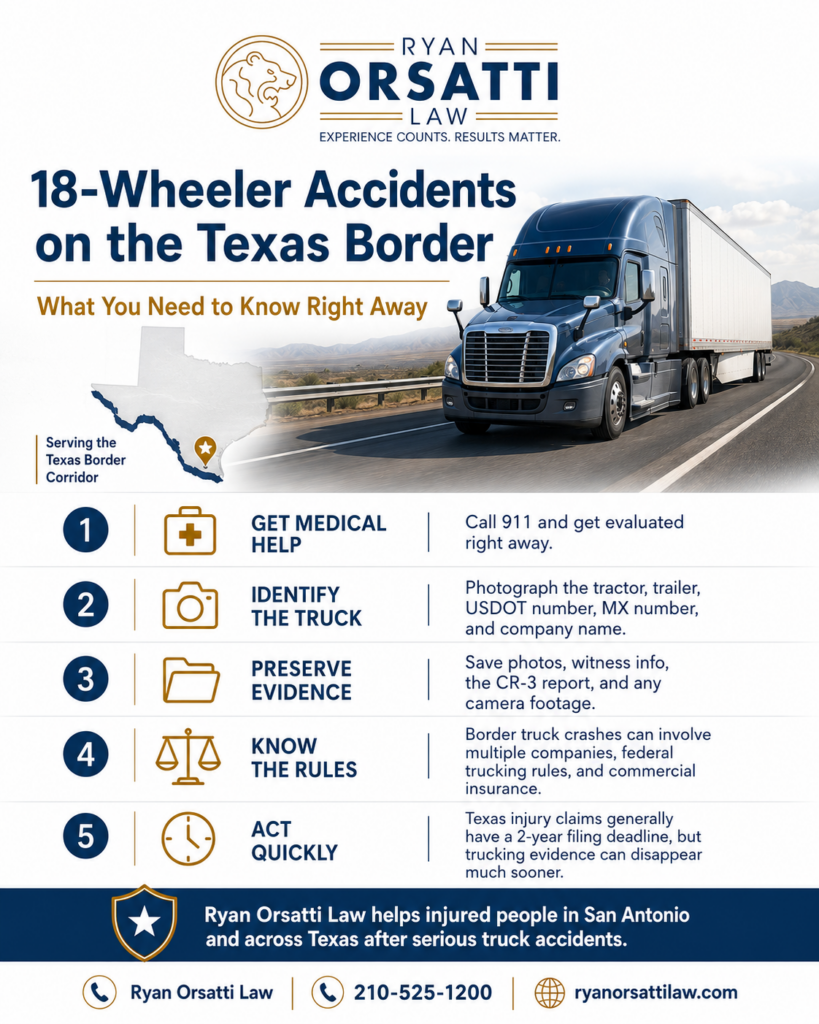
Why are 18-wheeler accidents on the Texas border different?
18-wheeler accidents on the Texas border are different because cross-border freight can involve federal trucking rules, Texas injury law, international cargo, multiple companies, and evidence located on both sides of the border. A crash near Laredo, McAllen, Brownsville, Eagle Pass, Del Rio, or El Paso may involve a Texas driver, a Mexico-domiciled carrier, a U.S. trailer owner, a freight broker, and a commercial insurer with separate reporting procedures.
The volume of truck traffic also matters. The Texas-Mexico border is not an ordinary traffic environment. TxDOT describes the Texas-Mexico Border Transportation Master Plan as a binational plan for safely and efficiently moving people and goods across the 1,254-mile Texas-Mexico border, which includes 34 border crossings. (Texas Department of Transportation)
Border truck crashes often involve:
- Tractor-trailers leaving or approaching a port of entry
- Drayage trucks moving freight within commercial zones
- Long-haul carriers taking international cargo beyond the border region
- Heavy traffic near warehouses, freight yards, customs facilities, industrial parks, and inspection points
- Mixed traffic involving passenger cars, pickups, buses, pedestrians, and commercial vehicles
NHTSA reported that in 2023, 5,472 people were killed in traffic crashes involving large trucks nationwide, and 70% of those killed were occupants of other vehicles. NHTSA also reported that Texas had the highest number of large trucks involved in fatal traffic crashes in 2023, with 705 large trucks involved. (Crash Stats)
What should I do first after an 18-wheeler accident on the Texas border?
After a Texas border 18-wheeler crash, your first priorities are safety, medical care, documentation, and evidence preservation. Do not try to argue fault at the scene. Instead, get emergency help, gather identifying information, and avoid signing documents or giving recorded statements to a trucking insurer before you understand your injuries and coverage issues.
Immediate checklist after a border truck crash
- Call 911 and request medical help. Even if you think you can drive away, adrenaline can hide symptoms from neck, back, brain, abdominal, and orthopedic injuries.
- Ask for a law enforcement report. Texas crash reports are often documented on a Texas Peace Officer’s Crash Report, commonly called a CR-3. TxDOT says people may obtain a CR-3 through its Crash Report Online Purchase System. (Texas Department of Transportation)
- Photograph the tractor and trailer separately. Get the company name, USDOT number, MX number if visible, license plates, trailer number, container number, placards, cab markings, and any broker or shipper markings.
- Photograph the whole scene. Include lane positions, skid marks, debris, traffic lights, signs, construction barrels, weather, lighting, bridge or port traffic, and nearby businesses that may have cameras.
- Identify witnesses. Get names, phone numbers, and short statements if safe. Border crash scenes can clear quickly because blocked truck corridors create traffic and trade disruptions.
- Do not give a recorded statement to the trucking insurer. You can report the claim, but you do not need to guess about speed, distance, injuries, or fault while you are still in pain or medicated.
- Get medical evaluation and follow instructions. Delayed treatment gives insurers an opening to argue that the crash did not cause the injury or that the injury was not serious.
- Save every document. Keep discharge paperwork, imaging orders, prescriptions, repair estimates, tow records, wage-loss notes, health insurance EOBs, and any texts or emails from insurers.
Who can be responsible for a Texas border 18-wheeler accident?
Responsibility for a Texas border 18-wheeler accident may fall on more than the truck driver. Depending on the facts, the motor carrier, truck owner, trailer owner, maintenance contractor, cargo loader, broker, shipper, or another driver may share responsibility for the crash.
Negligence means failing to use reasonable care under the circumstances. In trucking cases, negligence may include unsafe lane changes, following too closely, fatigue, speeding, distracted driving, poor maintenance, unsafe loading, brake problems, bad dispatch practices, or hiring an unqualified driver.
Ryan Orsatti Law evaluates these issues in Texas truck cases by looking beyond the crash report. A border truck collision may require review of motor carrier authority, driver qualification records, inspection history, dash camera footage, ECM or event data recorder information, ELD records, dispatch messages, bills of lading, and maintenance files. For more on company fault, see Ryan Orsatti Law’s guide to when a trucking company may be liable after a Texas truck accident.
What if the trucking company is based in Mexico?
A Mexico-domiciled trucking company can still be subject to U.S. motor carrier requirements when it transports freight into the United States. FMCSA states that every Mexico-domiciled motor carrier transporting freight from Mexico into the U.S. must have a USDOT number, FMCSA-assigned MX number, and either commercial-zone registration or long-haul operating authority, regardless of distance into the U.S. or trip frequency. (FMCSA)
FMCSA also explains that long-haul authority allows a Mexico-domiciled carrier to transport international cargo between Mexico and points in the United States beyond U.S.-Mexico border commercial zones. (FMCSA) That distinction matters because a crash near the border may involve a carrier limited to commercial-zone operations or a carrier authorized to travel deeper into Texas or across the country.
This does not mean a claim is automatically simple or difficult. It means the investigation should identify the correct carrier, its U.S. process agent, its insurance filing, the trailer owner, the freight documents, and whether the carrier was operating within the authority it claimed to have.
What evidence matters most after an 18-wheeler accident on the Texas border?
The most important evidence after a border truck accident is the evidence that proves who controlled the truck, what the driver was doing before impact, whether the vehicle was safe, and how the crash caused your injuries. In commercial trucking cases, the evidence can be more technical than in a regular car wreck.
Federal records rules make timing important. Under 49 CFR § 395.8, motor carriers must retain records of duty status and supporting documents for not less than six months from receipt. (eCFR) That does not mean every other type of evidence is held that long, and it does not mean the company will voluntarily send it without a proper preservation request.
| Evidence | Why it matters | Who may have it | Time risk |
|---|---|---|---|
| CR-3 crash report | Identifies parties, vehicles, apparent contributing factors, injuries, and investigating agency | TxDOT, DPS, local police, sheriff’s office | Usually available after processing, but not a full liability investigation |
| Tractor and trailer identifiers | Helps identify the correct motor carrier, trailer owner, and insurer | Driver, carrier, police report, photos | Can be lost if the truck leaves the scene before photos |
| ELD and records of duty status | Shows driving time, on-duty time, breaks, location, and fatigue issues | Motor carrier, ELD provider | Federal retention rules require at least six months for RODS and supporting documents |
| Dash camera and telematics | May show lane movement, speed, braking, following distance, and driver conduct | Carrier, fleet manager, camera vendor | Can be overwritten quickly depending on system settings |
| Maintenance and inspection records | Helps evaluate brakes, tires, lights, underride guards, and mechanical issues | Carrier, maintenance vendor, inspection station | Must be requested early and specifically |
| Load and freight documents | May identify shipper, broker, cargo, weight, route, and delivery pressure | Broker, shipper, carrier, consignee | Often held by separate companies |
| Medical records and bills | Prove injury, treatment, causation, and damages | Hospitals, doctors, imaging centers, health insurers | Gaps in care can create claim disputes |
Key takeaway: The earlier you preserve trucking evidence, the more likely you are to identify the correct carrier, insurer, and safety records before the claim becomes a dispute over missing documents.
Attorney Insight: In border truck cases, adjusters often start with the CR-3, photos, carrier identifiers, ELD records, dispatch records, and injury chronology. A case can become harder when the injured person waits months to request trucking data, gives a broad recorded statement, or delays medical care. In serious crashes, post-accident drug and alcohol testing can also matter because 49 CFR § 382.303 requires testing after certain fatal crashes and certain citation-based injury or tow-away crashes. (eCFR)
How does insurance work after a Texas border 18-wheeler accident?
Insurance after a Texas border 18-wheeler accident can involve commercial trucking coverage, personal auto coverage, health insurance, liens, and sometimes multiple insurers. The biggest mistake is assuming the truck driver’s insurance card tells the whole story. In commercial cases, coverage may involve the motor carrier, trailer, freight contract, broker, excess policy, or MCS-90 endorsement.
FMCSA lists minimum insurance requirements for many motor carriers. For for-hire non-hazardous property carriers with vehicles at or above 10,001 pounds GVWR, FMCSA lists a $750,000 bodily injury and property damage requirement. For certain hazardous materials, FMCSA lists $1,000,000, and for explosives, poison gas, or radioactive materials, $5,000,000. (FMCSA)
Your own Texas auto policy may also matter. TDI explains that Texas minimum personal auto liability coverage is 30/60/25, and Texas auto policies include personal injury protection unless rejected in writing. TDI also states that insurers must offer uninsured and underinsured motorist coverage, and rejection must be in writing. (Texas Department of Insurance)
What about medical bills, hospital liens, and subrogation?
Medical bills after a truck crash should be tracked from the beginning because liens and reimbursement claims can affect the final net recovery. Subrogation means a health insurer may claim a right to be reimbursed from part of a settlement. A hospital lien is a legal claim a hospital may assert against part of a personal injury recovery.
Texas Property Code Chapter 55 addresses hospital and emergency medical services liens, including a hospital’s lien on certain injury claims when hospital services are provided after an accident. (Texas Constitution and Statutes) In a serious border truck crash, medical bill strategy may involve health insurance, PIP, MedPay, letters of protection, hospital lien review, and negotiation of claimed balances.
How does Texas fault law apply to border truck accidents?
Texas fault law applies to border truck accidents through proportionate responsibility. Proportionate responsibility means Texas can reduce a claimant’s recovery by the claimant’s percentage of fault, and Texas Civil Practice & Remedies Code § 33.001 bars recovery if the claimant’s percentage of responsibility is greater than 50%. (Texas Constitution and Statutes)
This rule matters because trucking insurers may argue the injured driver merged improperly, followed too closely, stopped suddenly, drove in a blind spot, ignored signs, or caused the crash near an inspection point, port entrance, construction zone, or warehouse driveway.
Evidence is the answer to blame shifting. Photos, ELD data, vehicle damage, witness statements, dash camera video, road design, traffic signal timing, and event data can help evaluate whether the truck driver, motor carrier, another driver, or multiple parties contributed to the crash.
How long do you have to file a Texas border 18-wheeler accident claim?
In Texas, most personal injury lawsuits must be filed within two years from the date the claim accrues. Texas Civil Practice & Remedies Code § 16.003 also provides a two-year limitations period for injury resulting in death, with the wrongful death claim accruing on the death of the injured person. (Texas Constitution and Statutes)
That two-year deadline is not a reason to wait. Trucking evidence may be controlled by several companies and may be overwritten, repaired, moved, or lost long before the filing deadline. If a governmental unit is involved, such as a government vehicle, roadway defect, or public entity issue, Texas Civil Practice & Remedies Code § 101.101 generally requires notice not later than six months after the incident, and some city notice provisions can be shorter. (Texas Legislature Online)
When should you contact a Texas personal injury lawyer after a border truck crash?
You should contact a Texas personal injury lawyer quickly after a border truck crash if anyone was seriously injured, hospitalized, killed, blamed for the crash, contacted by a trucking insurer, or hit by a carrier connected to cross-border freight. Early legal work usually focuses on preserving evidence, identifying the correct defendants, locating insurance, and protecting the injured person from avoidable statement, lien, and documentation problems.
Ryan Orsatti Law helps injured people in San Antonio and across Texas evaluate serious truck and commercial vehicle claims, including crashes in South Texas and along major border freight corridors. The firm’s work may include sending preservation letters, identifying motor carrier authority, reviewing CR-3 details, investigating trucking company responsibility, coordinating medical bill documentation, and evaluating Texas proportionate responsibility issues.
Relevant resources from Ryan Orsatti Law include:
- San Antonio truck accident lawyer information
- Commercial vehicle accident cases in San Antonio
- McAllen truck accident lawyer guide for Rio Grande Valley crashes
- Statewide Texas injury case information
- Contact Ryan Orsatti Law
FAQ
Can I sue a Mexico-based trucking company after an 18-wheeler accident in Texas?
Yes, a Mexico-based trucking company may be part of a Texas injury claim if the crash happened in Texas and the company, driver, or vehicle contributed to the collision. FMCSA states that Mexico-domiciled freight carriers entering the U.S. need USDOT and MX identifying authority or registration, which can help identify the carrier and insurance. (FMCSA)
What should I photograph after an 18-wheeler accident near Laredo or the Rio Grande Valley?
Photograph the truck, trailer, license plates, USDOT number, MX number, company name, trailer number, container number, placards, road signs, skid marks, debris, lane positions, traffic signals, weather, lighting, and visible injuries. Also photograph nearby businesses, warehouses, bridge approaches, or intersections that may have cameras before the scene changes.
How long do trucking companies keep driver logs after a crash?
Federal rules require motor carriers to retain records of duty status and supporting documents for each driver for not less than six months from receipt. (eCFR) That retention rule is not a reason to wait because dash camera footage, telematics, repairs, dispatch messages, and third-party records may have different retention periods.
Is a Texas border truck accident claim filed in Texas or Mexico?
A truck accident claim is often handled in Texas when the crash occurred on a Texas roadway, but cross-border facts can affect parties, service, insurance, and evidence. The answer depends on where the crash happened, who owned and operated the truck, the carrier’s authority, the insurance policy, and whether any defendants are outside Texas.
Should I give a recorded statement to the trucking company’s insurer?
You should be cautious before giving a recorded statement to a trucking insurer. A statement can be used to lock you into early estimates about speed, distance, pain, treatment, or fault before you have the police report, medical diagnosis, or complete facts. You can report the claim without guessing.
What if the truck driver says I was partly at fault?
Texas proportionate responsibility can reduce a claim by the injured person’s percentage of fault and can bar recovery if the person is found more than 50% responsible. (Texas Constitution and Statutes) This is why crash reconstruction, photos, witnesses, truck data, and medical documentation matter in border 18-wheeler cases.
How soon should I request the Texas crash report after a border truck accident?
You should request the Texas CR-3 crash report as soon as it becomes available, but you should not wait for it before preserving evidence. TxDOT provides an online system for obtaining Texas Peace Officer’s Crash Reports. (Texas Department of Transportation) A CR-3 is useful, but it usually does not include every trucking record needed to evaluate fault.
What makes border 18-wheeler crashes harder than regular car accidents?
Border 18-wheeler crashes can involve international freight, Mexico-domiciled carriers, commercial zones, warehouses, multiple insurers, separate tractor and trailer ownership, and federal safety rules. They also happen on high-volume freight corridors where vehicles and evidence move quickly. Early investigation helps identify the right carrier, insurer, documents, and witnesses.
Ryan Orsatti Law
4634 De Zavala Rd, San Antonio, TX 78249
Phone: 210-525-1200
ryanorsattilaw.com
This blog is for informational purposes only, not legal advice. Reading it does not create an attorney-client relationship. Past results do not guarantee future results.
Hurt in an accident in San Antonio? Learn how a San Antonio car accident lawyer can help with your claim. Call 210-525-1200 or request a free consultation. There is no fee unless we win.
Related San Antonio legal resources
Primary legal and public-data sources
Ryan Orsatti Law
4634 De Zavala Road, San Antonio, TX 78249
Source links verified August 7, 2026.