
Quick Answer: If the insurance company undervalues your injury claim in Texas, do not sign a release or accept the offer until you understand fault, medical evidence, policy limits, liens, and future care. Texas generally gives injured people two years to file a personal injury lawsuit, but shorter notice deadlines can apply if a government entity is involved. Ryan Orsatti Law helps injured people in San Antonio and across Texas evaluate low offers, disputed fault, medical bill issues, and claim evidence before major decisions are made. (Texas Statutes)
Key Takeaways
- A low offer is not always the final answer. It often means the insurance company claims there is missing proof, disputed fault, limited coverage, or unresolved medical documentation.
- Texas fault law matters. If you are found more than 50% responsible, Texas law can bar recovery; if you are 50% or less responsible, your recovery can be reduced by your percentage of fault. (Texas Statutes)
- Ask for the insurer’s reason in writing. TDI advises that if the other driver’s insurer will not pay, you should ask for the reason in detail and in writing. (Texas Department of Insurance)
- Do not ignore medical liens and subrogation. Subrogation means a health insurer may claim a right to reimbursement from a settlement, and a hospital lien is a legal claim a hospital may assert against part of an injury recovery.
- The claim should be evaluated before the release is signed. Once a release is signed, the injury claim is usually over, even if later symptoms, bills, or liens become worse.
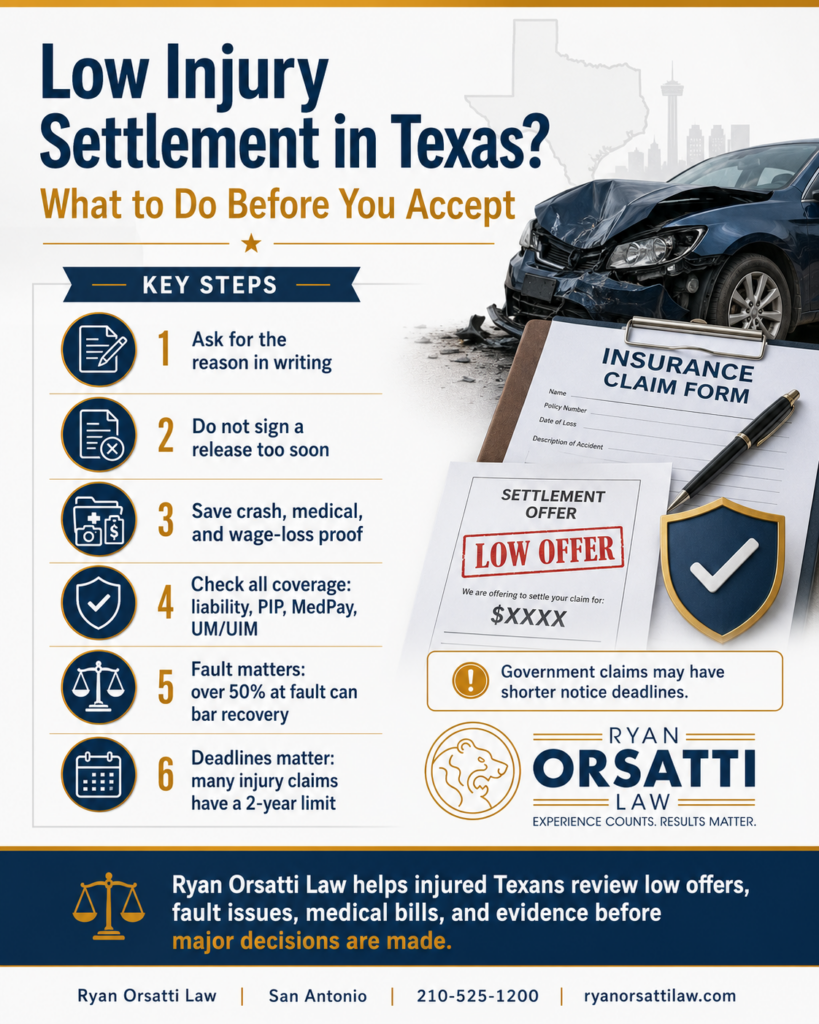
What Should I Do First If the Insurance Company Undervalues My Injury Claim in Texas?
If an insurance company undervalues your Texas injury claim, first ask for the offer and the reasons behind it in writing. Do not argue by phone, guess at your case value, or sign a release before reviewing medical records, bills, wage loss, photos, crash reports, witness information, and available insurance coverage.
Texas injury claims are evidence-driven. TxDOT reported 14,905 serious injury crashes in Texas in 2024, with 18,218 people sustaining serious injuries, which means insurers evaluate many claims through standardized fault, injury, and documentation filters. (TxDOT)
A practical first response is:
- Ask the adjuster to explain the valuation in writing.
- Request the policy limits if the claim involves serious injury.
- Do not sign a full and final release.
- Save every medical bill, medical record, diagnostic report, work note, and prescription receipt.
- Keep photos of vehicle damage, injuries, the scene, road conditions, and visible bruising or swelling.
- Identify every possible coverage source, including liability, PIP, MedPay, UM/UIM, health insurance, and umbrella coverage.
- Speak with a Texas personal injury lawyer if the injury is serious, fault is disputed, bills are unpaid, or the offer does not account for future care.
Ryan Orsatti Law has a related guide on insurance adjuster claim-value disputes in San Antonio that explains common devaluation tactics and practical claim responses. (Ryan Orsatti Law)
Why Do Texas Injury Claims Get Undervalued?
Texas injury claims get undervalued when the insurance company believes the file does not prove liability, injury severity, medical necessity, causation, or collectability. In plain English, the adjuster may be saying: “We do not think the evidence supports the amount you are asking for.”
That does not mean the adjuster is right. It means the next step is to identify the weak point in the file and fix it with documentation, legal analysis, or both.
| Insurance company position | What it usually means | Practical response |
|---|---|---|
| “Treatment was delayed.” | The insurer may argue the crash did not cause the injury. | Explain the delay with records, work notes, appointment availability, or symptom progression. |
| “The damage was minor.” | The insurer may be using vehicle photos to minimize injury. | Use medical findings, diagnostics, mechanism of injury, and consistent symptoms. |
| “You were partly at fault.” | The insurer may be reducing the offer under Texas proportionate responsibility. | Gather crash report details, witness statements, photos, video, and scene evidence. |
| “Your bills are too high.” | The insurer may dispute medical necessity or reasonableness. | Organize records, itemized bills, diagnoses, treatment plan, and provider opinions. |
| “There is limited coverage.” | The at-fault driver may not have enough insurance. | Check PIP, MedPay, UM/UIM, health insurance, umbrella policies, and other defendants. |
| “This is our final offer.” | The insurer may be testing whether you will accept before the file is complete. | Do not sign a release until damages, liens, and future care are reviewed. |
Key takeaway: A low offer should be treated as a diagnosis of the claim file, not as the final value of the case.
How Does Texas Fault Law Affect a Low Settlement Offer?
Texas fault law can sharply affect a low settlement offer because insurers often reduce offers when they believe the injured person shares blame. Comparative responsibility means Texas can reduce your recovery by your percentage of fault, and Texas Civil Practice and Remedies Code Chapter 33 bars recovery if the claimant’s percentage of responsibility is greater than 50%. (Texas Statutes)
For example, if an insurer argues you were speeding, changed lanes unsafely, failed to yield, or delayed braking, the offer may be discounted even when the other driver was clearly negligent. The practical answer is not just to say “I disagree.” The practical answer is to preserve the evidence that proves how the crash happened.
In San Antonio and Bexar County crashes, that evidence may include:
- TxDOT CR-3 crash report
- Body camera or dash camera footage
- 911 audio
- Traffic camera or business surveillance video
- Witness statements
- Vehicle damage photos
- Event data recorder information in serious crashes
- Roadway photos from I-10, I-35, Loop 410, Loop 1604, US-281, or the crash location
TxDOT is the custodian of Texas crash records, and law enforcement crash reports can be obtained through TxDOT’s Crash Report Online Purchase System by people with a proper interest in the crash. (TxDOT)
What Evidence Should I Save Before Responding to a Low Offer?
Before responding to a low injury offer, save the evidence that proves fault, injury, medical expenses, lost income, and the effect on daily life. Insurance companies usually evaluate injury claims through documents, not emotion, so the strongest response is a complete, organized claim file.
Use this checklist before making a counteroffer:
- Crash proof: CR-3 crash report, photos, video, witness names, vehicle damage, repair estimate, and scene details.
- Medical proof: ER records, urgent care records, specialist notes, imaging reports, therapy notes, prescriptions, work restrictions, and future treatment recommendations.
- Billing proof: Itemized bills, health insurance payments, outstanding balances, letters of protection, and lien notices.
- Income proof: Pay stubs, employer letters, tax records, missed work dates, and proof of reduced hours.
- Daily-life proof: Photos, activity limitations, sleep disruption, missed family responsibilities, and written symptom tracking.
- Coverage proof: At-fault liability limits, your declarations page, PIP, MedPay, UM/UIM, umbrella coverage, and any commercial policy information.
- Communication proof: Adjuster emails, letters, recorded statement requests, offer letters, denial letters, and claim numbers.
TDI recommends getting witness information, sending the police accident report to the insurance company, and providing medical reports and bills if you were injured. (Texas Department of Insurance)
Should I Give a Recorded Statement or Sign a Release After a Low Offer?
You should be cautious about recorded statements and should not sign a release after a low offer unless you understand exactly what rights you are giving up. A recorded statement may be used to challenge fault, symptoms, prior injuries, treatment gaps, or the timing of pain complaints.
A release is more serious. A full and final release usually ends the claim against the released parties. That can become a major problem if you later discover unpaid hospital liens, a need for surgery, an underinsured motorist issue, or a health insurance reimbursement claim.
If the other driver’s insurance company asks for a recorded statement, remember that TDI explains you do not have a contract with that insurer and do not have the same options you would with your own company. (Texas Department of Insurance)
What If My Medical Bills Are Higher Than the Insurance Limits?
If your medical bills are higher than the at-fault driver’s insurance limits, you should look for additional coverage before accepting a settlement. Texas minimum auto liability coverage is 30/60/25, meaning at least $30,000 for injuries per person, $60,000 per accident, and $25,000 for property damage, which may be too low for a serious injury. (Texas Department of Insurance)
Other possible payment sources may include:
- PIP: Personal injury protection, which may help pay medical bills and lost wages.
- MedPay: Medical payments coverage, which may help pay medical bills.
- UM/UIM: Uninsured/underinsured motorist coverage, which may apply if the at-fault driver has no insurance or not enough insurance.
- Health insurance: May pay accident-related treatment, but may later assert subrogation.
- Umbrella coverage: Extra liability coverage that may apply in serious cases.
- Additional defendants: Employers, commercial vehicle companies, property owners, bars, contractors, or vehicle owners may be relevant depending on the facts.
Texas insurers must offer PIP and UM/UIM coverage on new auto policies, and rejection must be in writing. (Texas Department of Insurance) Ryan Orsatti Law also has a Texas UM/UIM guide that explains how uninsured and underinsured motorist coverage can affect real-world crash claims. (Ryan Orsatti Law)
How Do Liens and Subrogation Affect a Texas Injury Settlement?
Liens and subrogation affect a Texas injury settlement because the gross settlement is not the same as the client’s net recovery. Subrogation means a health insurer may claim a right to be paid back from the settlement, while a hospital lien is a legal claim a hospital may assert against part of the injury recovery.
Under Texas Property Code Chapter 55, a hospital lien may attach to an injury claim when hospital services are provided for accident injuries attributed to another person’s negligence, and the statute includes a 72-hour timing requirement for attachment. (Texas Statutes)
This is one reason a low offer can be dangerous. A settlement that looks acceptable on paper may leave little or nothing after medical balances, lien claims, health insurance reimbursement claims, attorney’s fees, case expenses, and unpaid treatment are addressed.
How Long Do I Have to Challenge an Undervalued Texas Injury Claim?
In many Texas personal injury cases, you generally have two years from accrual to file suit, but you should not wait until the deadline is close. Texas Civil Practice and Remedies Code § 16.003 is the core two-year limitations statute for personal injury claims, and separate notice deadlines may apply to claims involving governmental units. (Texas Statutes)
A government vehicle crash, dangerous roadway claim, city bus incident, police crash, or public-property injury may involve the Texas Tort Claims Act. Section 101.101 provides a six-month notice rule, and city charter or ordinance notice provisions may require notice sooner. (Texas Legislature Online)
The safest practical rule is simple: if the claim involves serious injury, a government entity, a commercial vehicle, a disputed crash report, or an insurer delaying evaluation, get the timeline reviewed quickly.
When Does a Texas Personal Injury Lawyer Add Value to an Undervalued Claim?
A Texas personal injury lawyer can add value when the low offer is caused by disputed fault, missing medical proof, future care, unpaid bills, liens, policy limits, or pressure to sign a release. The lawyer’s job is not just to argue for a higher number; it is to build the evidence and coverage picture needed for a fair evaluation.
Ryan Orsatti Law helps injured people in San Antonio and across Texas evaluate these decision points, including fault disputes, medical documentation, insurance coverage, liens, and whether litigation is needed to preserve rights. The firm’s related guide on what makes a strong personal injury lawyer explains the importance of evidence, treatment planning, claim build-out, negotiation leverage, and filing suit when needed. (Ryan Orsatti Law)
Attorney Insight: Low offers often come from incomplete files. Adjusters discount claims when records do not connect the injury to the incident, when treatment gaps are unexplained, when future care is not documented, or when liens are unknown. A strong demand usually waits until diagnosis, treatment plan, billing status, lien status, and coverage issues are clear.
What Should Ryan Orsatti Law Review Before You Accept or Reject an Offer?
Ryan Orsatti Law should review the offer letter, release, medical records, bills, lien notices, crash report, photos, coverage information, and all adjuster communications before you accept or reject a serious injury offer. The goal is to understand the legal value, collectability, risks, and net recovery before a final decision is made.
Important documents include:
- The written settlement offer
- The proposed release
- The CR-3 crash report
- Photos and video
- Medical records and bills
- Health insurance explanation of benefits
- Hospital lien notices
- Letters of protection
- PIP, MedPay, and UM/UIM declarations pages
- Wage loss documentation
- Prior injury records if the insurer is raising causation issues
- Any denial letter or comparative fault explanation
Ryan Orsatti Law is a San Antonio personal injury firm with experience handling car accident, truck accident, commercial vehicle, motorcycle, catastrophic injury, and wrongful death claims across Texas. (Ryan Orsatti Law)
FAQs
Can I reject a low insurance settlement offer in Texas?
Yes. You can reject a low settlement offer in Texas if you have not signed a release. A rejection should usually be supported by evidence, not just disagreement. Ask the insurer for its reasoning in writing, identify what proof is missing, and make sure medical bills, future care, liens, wage loss, and coverage issues are reviewed before countering.
Can TDI make the insurance company pay my personal injury claim?
TDI can help with insurance complaints, but it does not act as your personal injury lawyer or decide all disputed injury damages. TDI says that if you file a complaint about another driver’s insurer, the company must write back explaining why it denied the claim or paid a certain way. Legal help may still be needed. (Texas Department of Insurance)
What if the other driver’s insurer says I was partly at fault?
If the insurer says you were partly at fault, the offer may be reduced under Texas proportionate responsibility rules. Texas bars recovery if your percentage of responsibility is greater than 50%, and damages can be reduced by your percentage of fault when recovery is not barred. Evidence such as photos, witnesses, video, and the CR-3 matters. (Texas Statutes)
Should I use my health insurance after a Texas car crash?
Often, using health insurance can help keep treatment moving, but it may create subrogation or reimbursement issues that must be handled before settlement. You should keep every explanation of benefits, bill, and lien notice. Do not assume the settlement number is your net recovery until health insurance and medical balance issues are reviewed.
Does a low offer mean the insurer is acting in bad faith?
Not always. A low offer may result from disputed fault, missing records, policy limits, or an adjuster’s evaluation of medical proof. Bad faith and unfair settlement issues are more specific legal questions, especially when your own insurer is involved. Texas Insurance Code Chapters 541 and 542 address certain unfair settlement and claim-handling conduct. (Texas Statutes)
Do I need a lawyer if the insurer already admitted fault?
You may still need a lawyer even if fault is admitted because value can still be disputed. The insurer may contest medical necessity, causation, treatment gaps, future care, lost wages, liens, or policy limits. Legal review is especially important before signing a release in cases involving serious injury, surgery, unpaid bills, or UM/UIM coverage.
Ryan Orsatti Law
4634 De Zavala Rd, San Antonio, TX 78249
Phone: 210-525-1200
ryanorsattilaw.com
This blog is for informational purposes only, not legal advice. Reading it does not create an attorney-client relationship. Past results do not guarantee future results.
Hurt in an accident in San Antonio? Learn how a San Antonio car accident lawyer can help with your claim. Call 210-525-1200 or request a free consultation. There is no fee unless we win.
Related San Antonio legal resources
Primary legal and public-data sources
- TxDOT: Texas crash reports, data, and statistics
- Texas Civil Practice and Remedies Code Chapter 33: proportionate responsibility
Ryan Orsatti Law
4634 De Zavala Road, San Antonio, TX 78249
Source links verified August 7, 2026.